Negative Number: 14219
Latitude: 37.0
Longitude: 77.0
Geographical Classification:
North America: United States and Possessions (Except Asiatic Possessions): South Atlantic States: Virginia
Card Front:
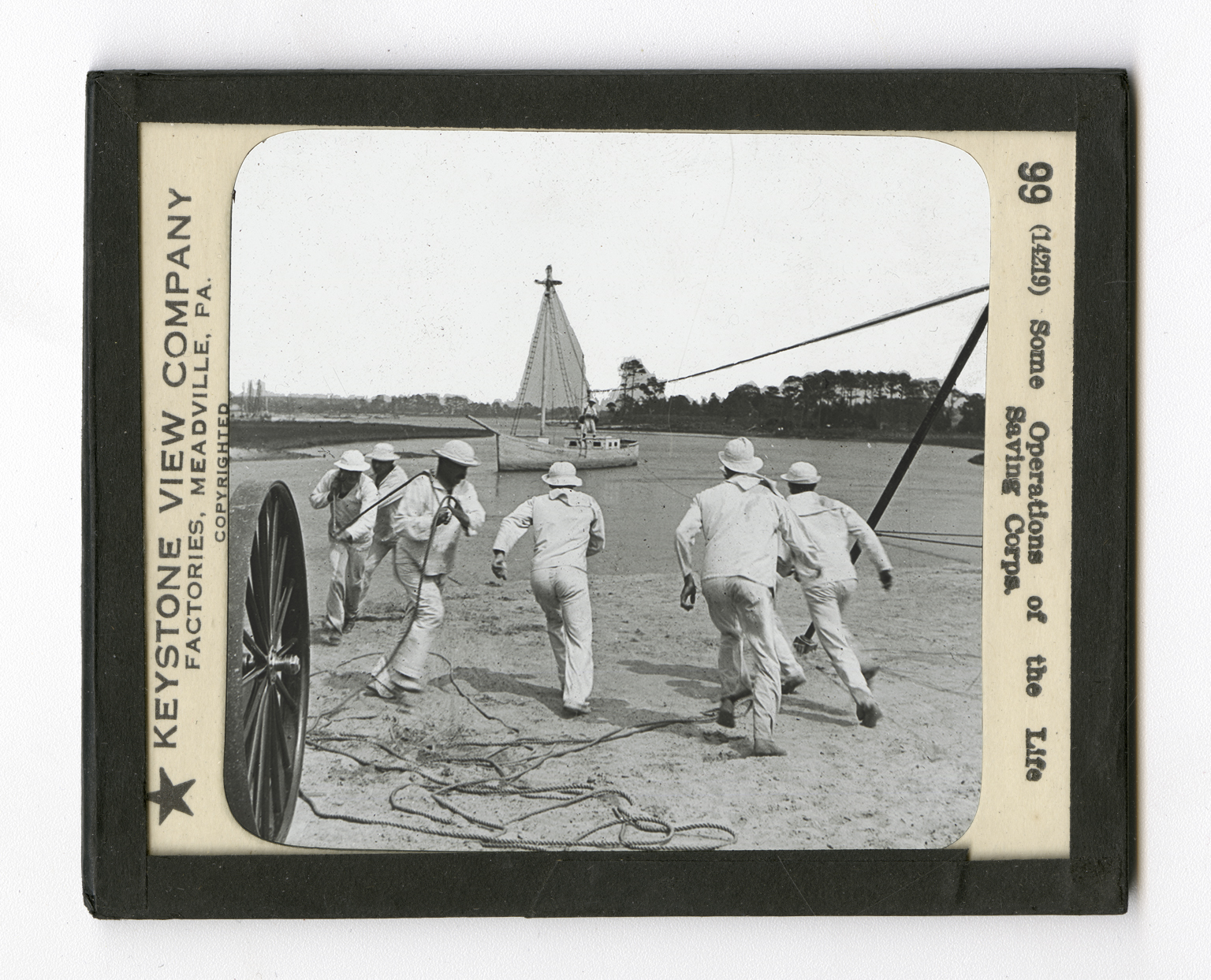
Unless you live along the seashore or have made a voyage you cannot fully understand the work that these men are doing. It is their business to save lives from shipwrecked boats. The view here shows how one life-saving squad has fired a rope from a gun to a small vessel in order to bring the man ashore. You can see that they are working rapidly, as they have to in the case of a real wreck. All along our coasts are dangerous reefs and bars. On these every year many ships become stranded. Then it is that the men of the life-saving stations near by perform their wonderful services. Sometimes they have to row a boat out in a heavy surf and bring the passengers ashore, a few at a time. At other times it is impossible for a boat to approach a larger vessel on account of the pounding waves. Then ropes must be
Card Back:
thrown and the people lowered one at a time, either in baskets or in buoys such as are here shown. Frequently a strong swimmer of the squad will attempt to each a ship by swimming. In that case he ties his rope around his waist so that if he is knocked insensible he can be dragged in. Should he reach the ship in distress, the rope will serve to drag a heavier one to the vessel so that an arrangement like the one shown here can be set up. The United States is the only country in the world that has a life-saving service run by the government. Stations are placed at many points along the Atlantic, the Pacific, and the shores of the Great Lakes. Each of these crews consists generally of a keeper and six to eight surfmen. We maintain nearly 300 of these stations.