Negative Number: 20197
Latitude: 39.0
Longitude: 76.0
Geographical Classification:
North America: United States and Possessions (Except Asiatic Possessions): South Atlantic States: Virginia
Card Front:
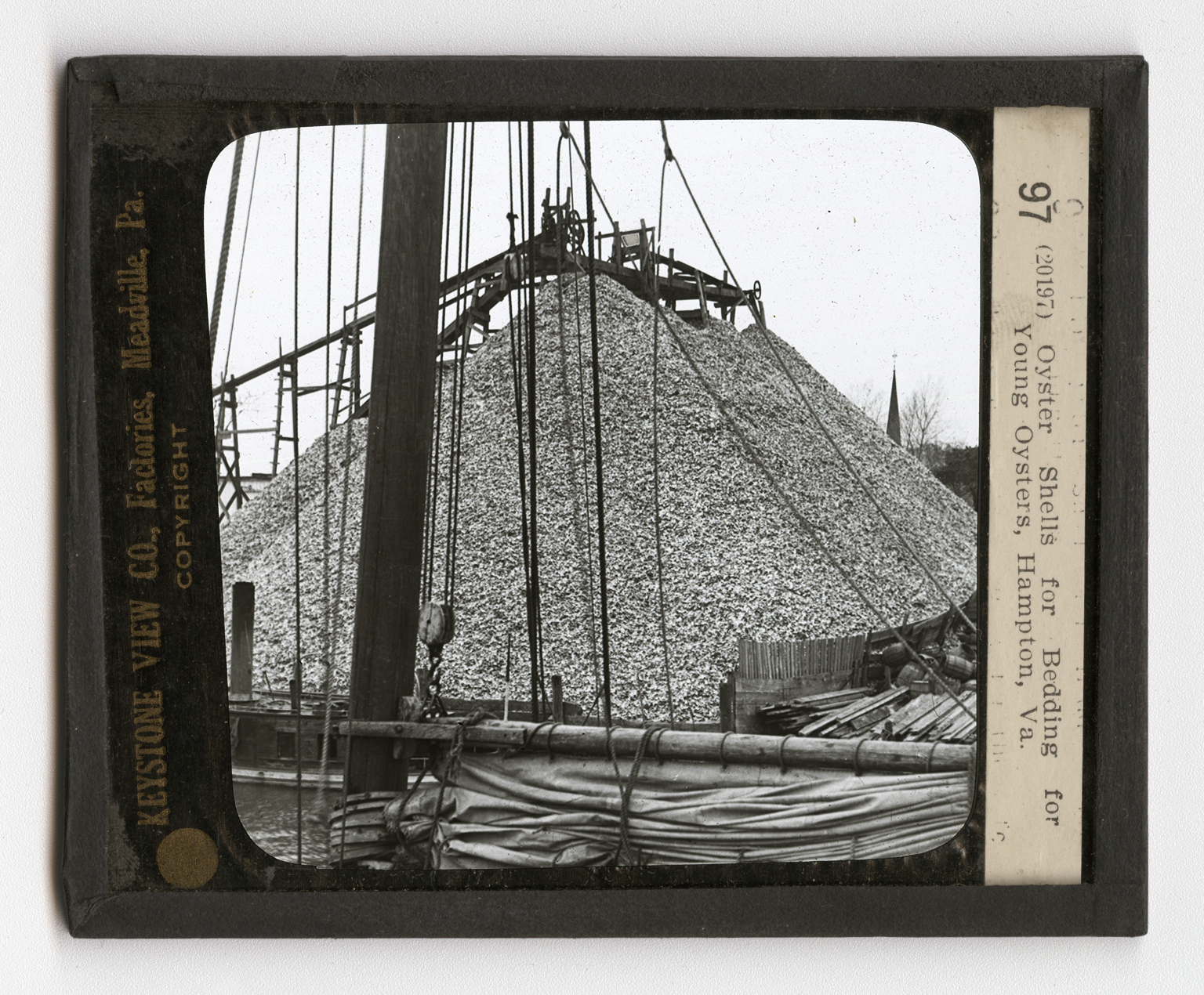
Millions of oysters are caught in the waters along the shores of the Middle Atlantic States and of the southern New England States, each fall and winter. At the rate they are caught, the natural supply would soon be removed if steps were not taken to plant new beds. One of the queerest of our modern forms of farming is oyster farming. Beds are laid out in shallow water, and are made ready for the planting of young oysters. The making ready consists of spreading on the bottom, shells or stones so that the young oysters can attach themselves to these. The view shows a mountain of the shells of husked oysters at Hampton, Virginia, ready to be sowed in oyster beds. These shells are scooped into flat-bottomed freight boats which take them out to the oyster fields and scatter them broadcast. The young oysters may be planted either of
Card Back:
two methods. Seed oysters may be put down in the prepared beds, where they are left undisturbed to lay their eggs. Here thousands of young are hatched and grow naturally to adult size before any fishing is done. The other way is to bring the young hatch to the beds and free them in the water. These young oysters have been hatched in special hatcheries. Most of these hatcheries are under the control of the United States Fish and Game Commission. Some are controlled by states, and still others may belong to firms interested in oyster farming. When the young are born they are only tiny white dots. When they are a year old they are not an inch in diameter. They do not grow to full size until they are five years old. You can tell by this that oyster farming must be done on an extensive scale in order to be profitable.