Negative Number: 16647
Latitude:
Longitude:
Geographical Classification:
Earth Neighbors
Card Front:
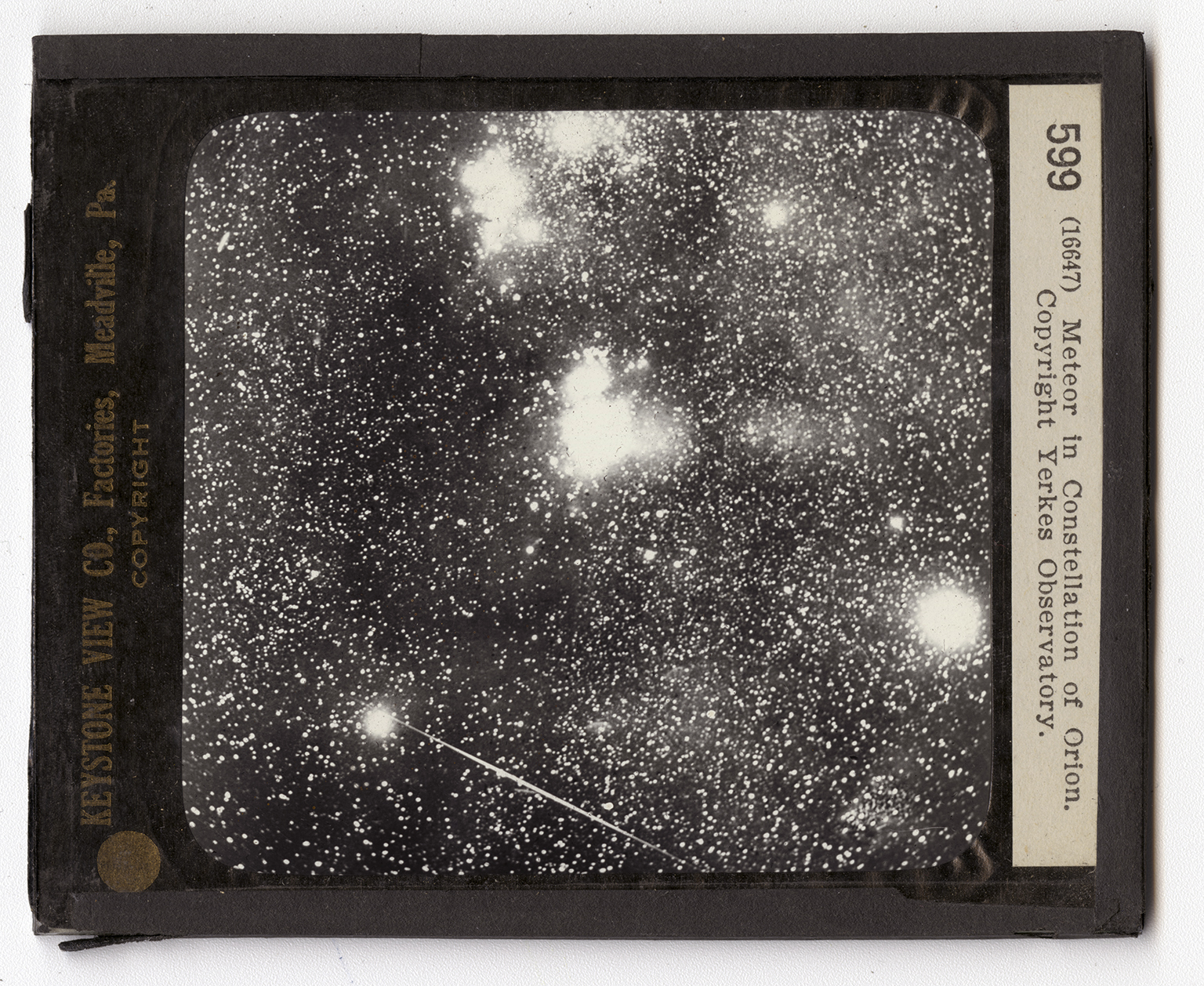
The earth in its revolution about the sun encounters small bodies called meteroids. Their velocity is so great that the resistance of the earth's atmosphere quickly raises their surfaces to white heat, thus converting them into meteors. These are shooting stars that you can see in the heavens almost any clear night. Sometimes they are very large, weighing tons. There is now in the Hall of the Royal Academy at Stockholm a fragment of meteoric iron that weighs 20 tons. We know from this that meteors actually fall to the earth. For a long time this was doubted by astronomers, although history relates several instances of a "star" colliding with the earth. Not long since, people looked upon a falling star as some kind of miracle, or sign. In the view only the path of the meteor is shown. It is the bright streak that stands out in the bottom of the view. Back of it are thou-
Card Back:
sands of tiny white spots. These are all stars. The great, bright spots are stars in the constellation of Orion. The three stars in line in the upper part of this view form Orion's "belt". The large spot in the center is the Great Nebula. The bright star to the right is Rigel, and the one near the meteor is Saiph. When you look at this scene you will recall the rime: "Twinke, twinkle, little star, How I wonder what you are." Though we know a little about the stars, we still wonder what they are. [This photograph was made on the night of November 15th, 1904, at the Yerkes Observatory by E. E. Barnard and Frank Sullivan. The meteor was about 90 miles above the earth's surface at the time.]