Negative Number: 16765
Latitude:
Longitude:
Geographical Classification:
Earth Neighbors
Card Front:
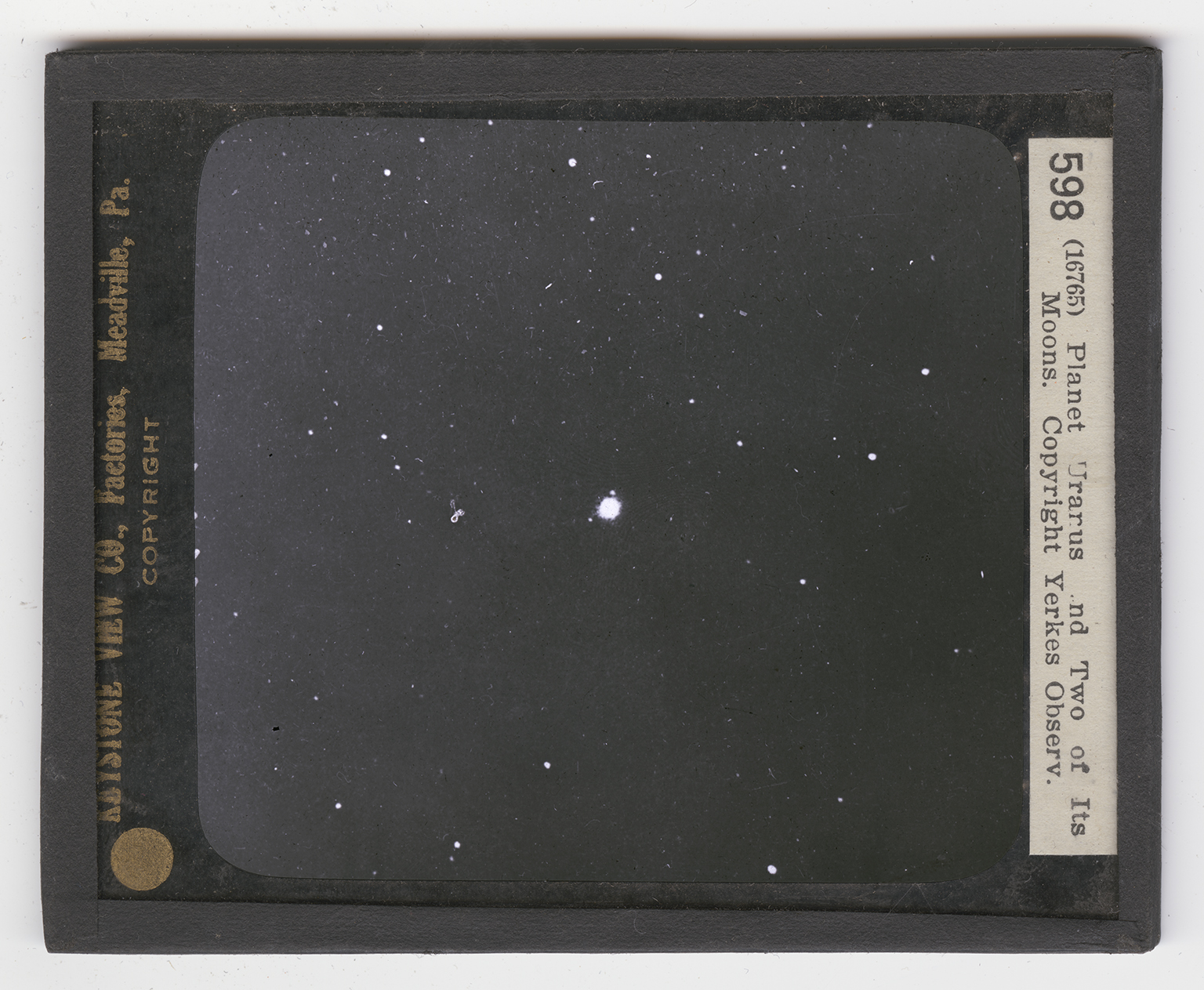
The large white spot in the center of the picture is the way the planet Uranus appears through the two-foot reflecting telescope of the Yerkes Observatory. The picture was made by Mr. E. P. Hubble. Just above Uranus, and also to the left and below it, there are two small white spots. These are two of the satellites that beling to the planet. The one above is known as Oberon; the other is called Titania. The planet has two other satelites called Ariel and Umbriel. They are smaller and closer to the planet than the two that you see, and are lost in the image of the planet itself. At the time these photographs were taken, Uranus was 1,764,000,000 miles from the Earth. Its distance from the sun is about 1,782,000,000 miles. Its diameter is about 35,000 miles, or about four times that of the Earth. It takes it 84 of our years to revolve around the sun.
Card Back:
This planet was the first to be discovered with the telescope. Sir William Herschel found it in 1781. Previous to this time it has been mistaken by those who had seen it for a fixed star. Six years after the discovery of the planet Sir William observed its two satellites here shown. The other two were found by Lasell in 1851. Uranus is so far away from the Earth that little of general interst has been discovered about it. In our Solar System we now know of eight large planets. The one nearest the sun is Mercury; then comes Venus, the bright evening star; then our own Earth; then Mars, Jupiter, Saturn, Uranus, Neptune. There are a great many smaller planets. We know of about 450 of these. There are as many as 1000 in all. Some astronomers guess that there may be planets even farther away than Neptune.