Negative Number: 16767
Latitude:
Longitude:
Geographical Classification:
Earth Neighbors
Card Front:
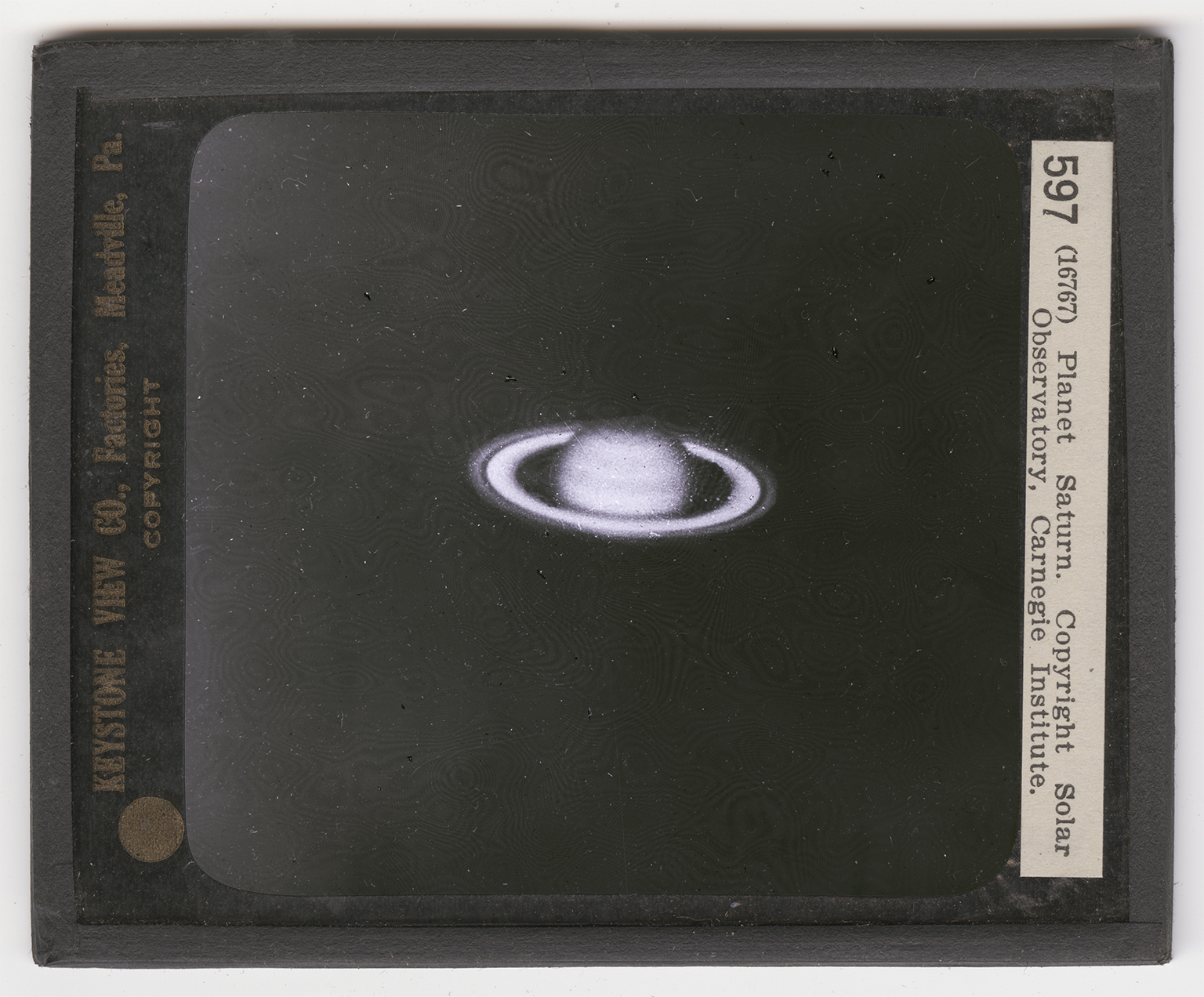
This is one of the most beautiful objects of the sky and it unique among the planets. In the telescope it shines with a strong golden color. The mean diameter of the globe of Saturn is 73,000 miles - nine times that of the Earth. It would make about 760 Earths, in bulk. The extreme diameter of the rings is 173,000 miles. The breadth of the outside ring is more than 10,000 miles. The outer diameter is of the inside ring is 145,000 miles. It's breadth is 16,500 miles. It is more than 10,000 miles from the planet to the inner edge of the inside ring. The space between the two rings is about 2000 miles. These rings are perhaps less than 100 miles in thickness. They are so thin that when on edge to us they are invisible in all telescopes. This invisibility occurs every 15 years, the last of which was in 1907. It has been proved that the rings are made up of countless numbers of very small satellites revolving around the
Card Back:
planet like swarms of tiny moons close together. The mean distance of Saturn from the Sun is nearly 900,000,000 miles. Its weight or density is about one-fifth that of water. That is, if there was an ocean big enough to hold it, it would float like a cork. No life such as we know on the earth, could exist on Saturn. The rings about Saturn perplexed ancient astronomers. They called it the planet with ears. Little as we still know, we have some facts about it. We know its huge size and about its light weight. We know its days are only 10 hours and 14 minutes long. But we do not know of what the planet is made. It may be of gases and vapors, or it may be solid. This photograph was made with the great five-foot reflecting telescope at the Solar Observatory of the Carngegie Institution at Mount Wilson, California, on November 19, 1911, by E. E. Barnard of the Yerkes Observatory Staff.