Negative Number: 16646
Latitude:
Longitude:
Geographical Classification:
Earth Neighbors
Card Front:
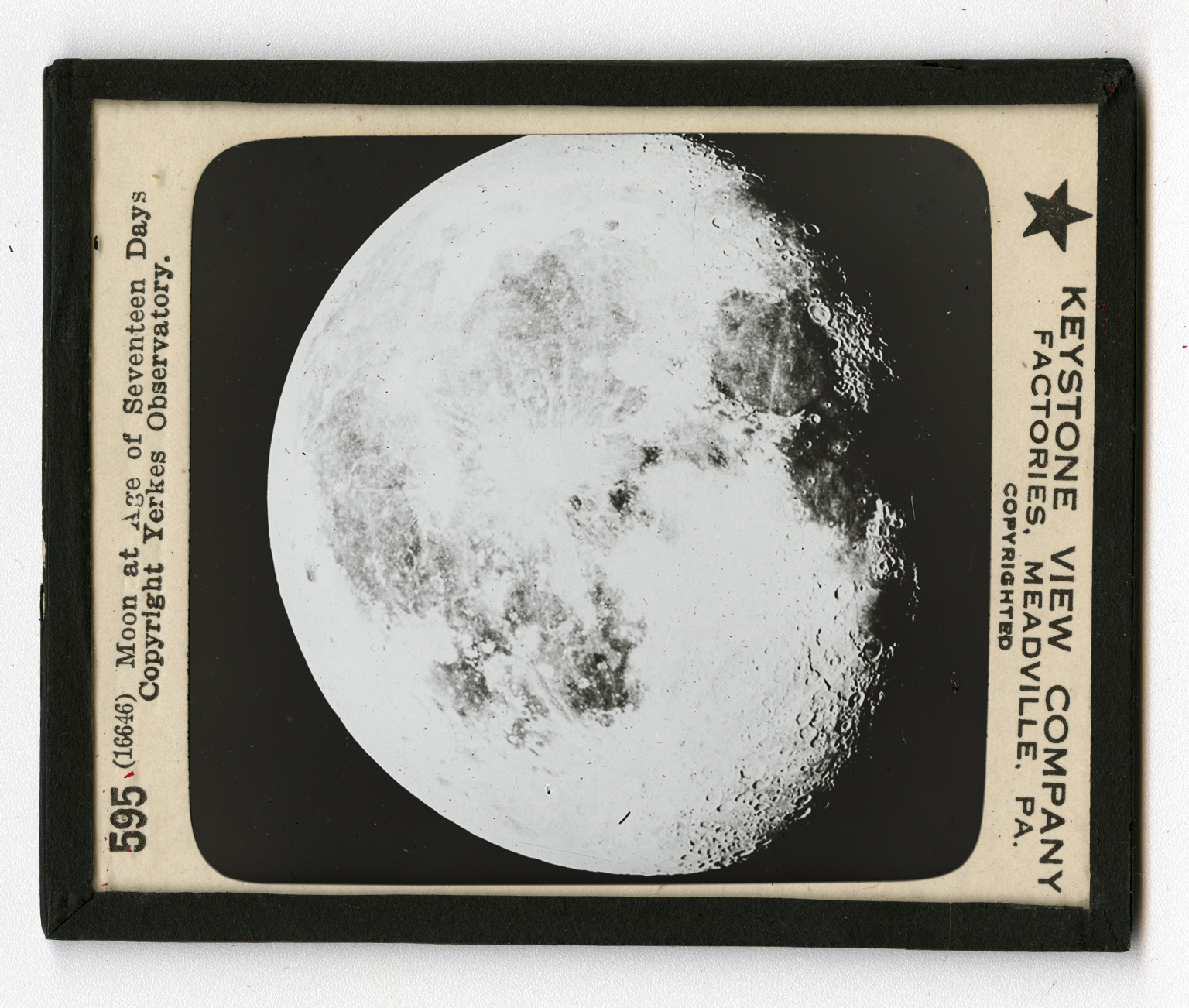
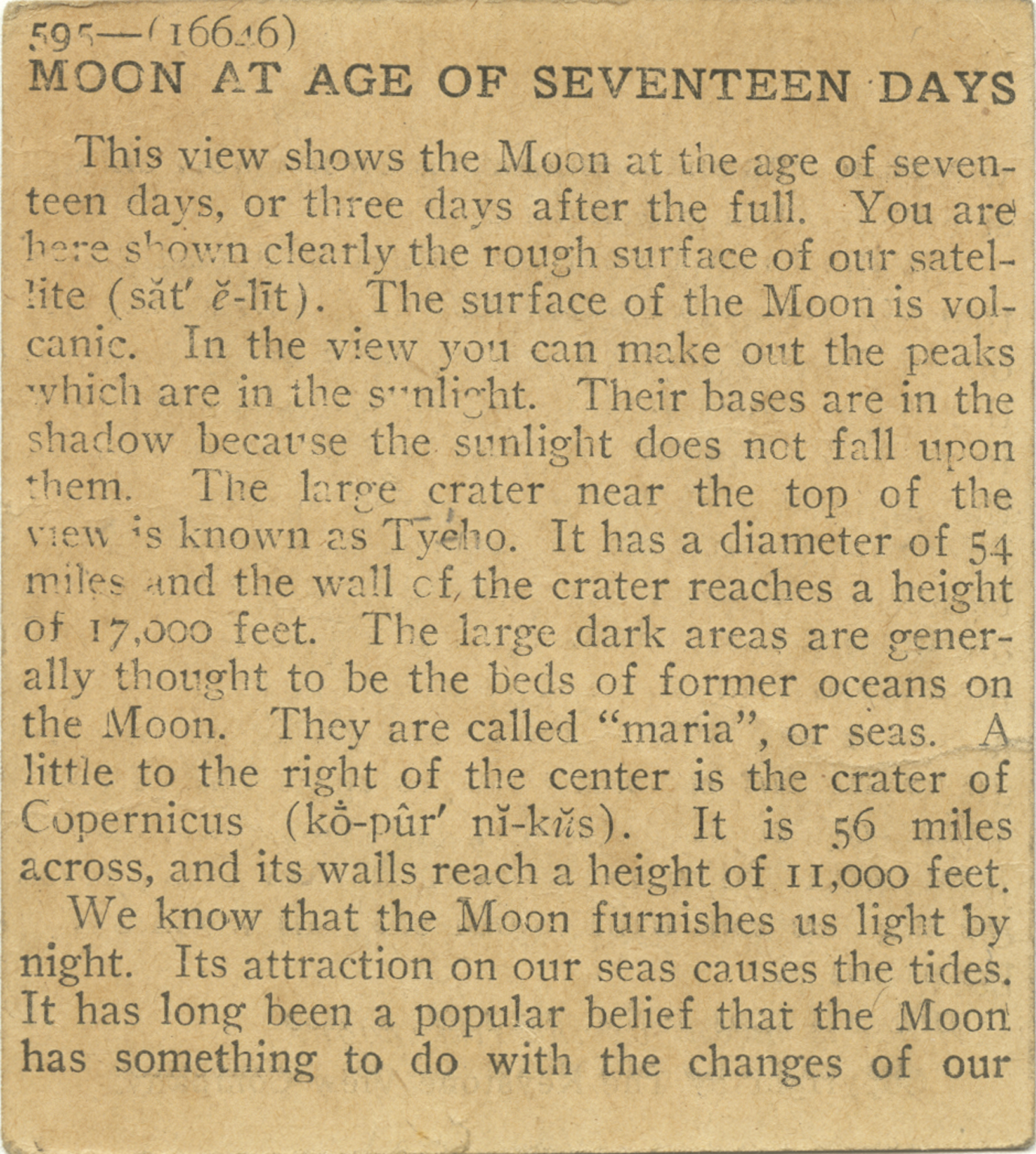
This view shows the Moon at the age of seventeen days, or three days after the full. You are here shown clearly the rough surface of our satelite. The surface of the Moon is volcanic. In the view you can make out the peaks which are in the sunlight. Their bases are in the shadow because the sunlight does not fall upon them. The large crater near the top of the view is know as Tyeho. It has a diameter of 54 miles and the wall of the crater reaches a height of 17,000 feet. The large dark areas are generally thought to be the beds of former oceans on the Moon. They are called "maria", or seas. A little to the right of the center is the crater of Copernicus. It is 56 miles across, and its walls reach a height of 11,000 feet. We know that the Moon furnishes us light by night. Its attraction on our seas causes the tides. It has long been a popular belief that the Moon has something to do with the changes of our
Card Back:
weather. There is no proof of this, however, and scientists do not believe it. Another popular belief, which is also wrong, is that the Moon is nearer the Earth when seen low on the horizon. This belief comes about because the Moon looks to be larger than when it is in mid-sky (zenith). The real truth is exactly the opposite. The Moon really should appear larger in the mid-sky than it does on the horizon, because it it closer to us in the zenith than it is on the horizon. The eye is simply tricked. A man on top of a thirty-story building looks only a few inches in height. Place him the same distance away on the level and he looks to be natural size. When the Moon is in the zenith we have no objects with which to compare it. It looks largest on the horizon when compared with trees and buildings. What is meant by the full moon?