Negative Number: 16648
Latitude:
Longitude:
Geographical Classification:
Earth Neighbors
Card Front:
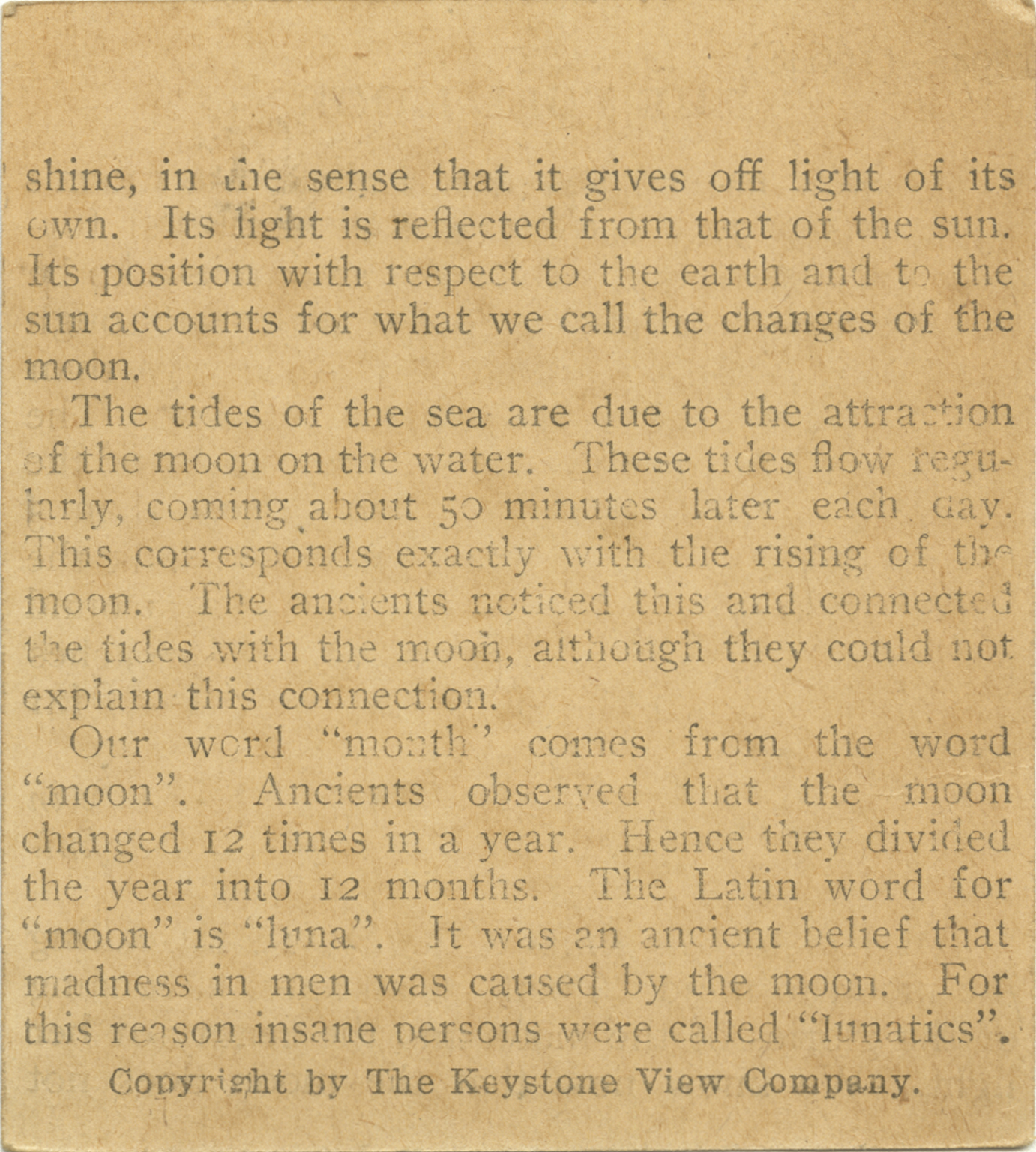
If you ever had any doubt about the moon's being round that doubt ought to be buried forever from this time. Here the moon looks to be an almost perfect sphere. And so it is. The rough places on its surface are no more, relatively, than the ridges on the surface of an orange. The diameter of the moon is 2160 miles, over 1/4 of the diameter of the earth. Its area is less than 5 times that of the United States, and in bulk the earth would make 48 moons. It rotates around the earth in 27 1/3 days. The nearest it approaches the earth is about 221,000 miles. It gets as far away as 253,000 miles. The moon is the earth's only satellite. (Look in your dictionary for the pronounciation and definition of this word.) We can searcely think of night without calling the moon to mind. Poets, in all ages, have sung of the glories of the moon and the beauty of her light. We know now that the moon does not
Card Back:
shine, in the sense that it gives off light of its own. Its light is reflected from that of the sun. Its position with respect to the earth and to the sun accounts for what we call the changes of the moon. The tides of the sea are due to the attraction of the moon on the water. These tides flow regularly, coming about 50 minutes later each day. This corresponds exactly with the rising of the moon. The ancients noticed this and connected the tides with the moon, although they could not explain this connection. Our word "mouth" comes from the word "moon". Ancients observed that the moon changed 12 times in a year. Hence they divided the year into 12 months. The Latin word for "moon" is "luna". It was an ancient belief that madness in men was caused by the moon. For this reason insane persons were called "lunatics".