Negative Number: 16749
Latitude: 40.0
Longitude: 75.0
Geographical Classification:
North America: United States and Possessions (Except Asiatic Possessions): Middle Atlantic States: New Jersey
Card Front:
The dairy industry in our country is relatively young. In Europe this industry has been carried on for hundreds of years, especially in some of its forms. Butter and cheese making in the countries of Norway and Sweden, Switzerland, France, England, and Holland are old trades handed down from generation to generation. But in this country, not many years ago each family owned its own cow, or cows. The first step towards the modern dairy farm came with the growth of cities. When the towns became too large for the cow to be tethered on the village green, a herd boy was hired by the community to drive the cattle to pasture. As the cities grew, this method failed to work. Now every family in the city, no matter how large the city may be, can be supplied with fresh milk and cream every morning. These are brought from the bottling works to the houses
Card Back:
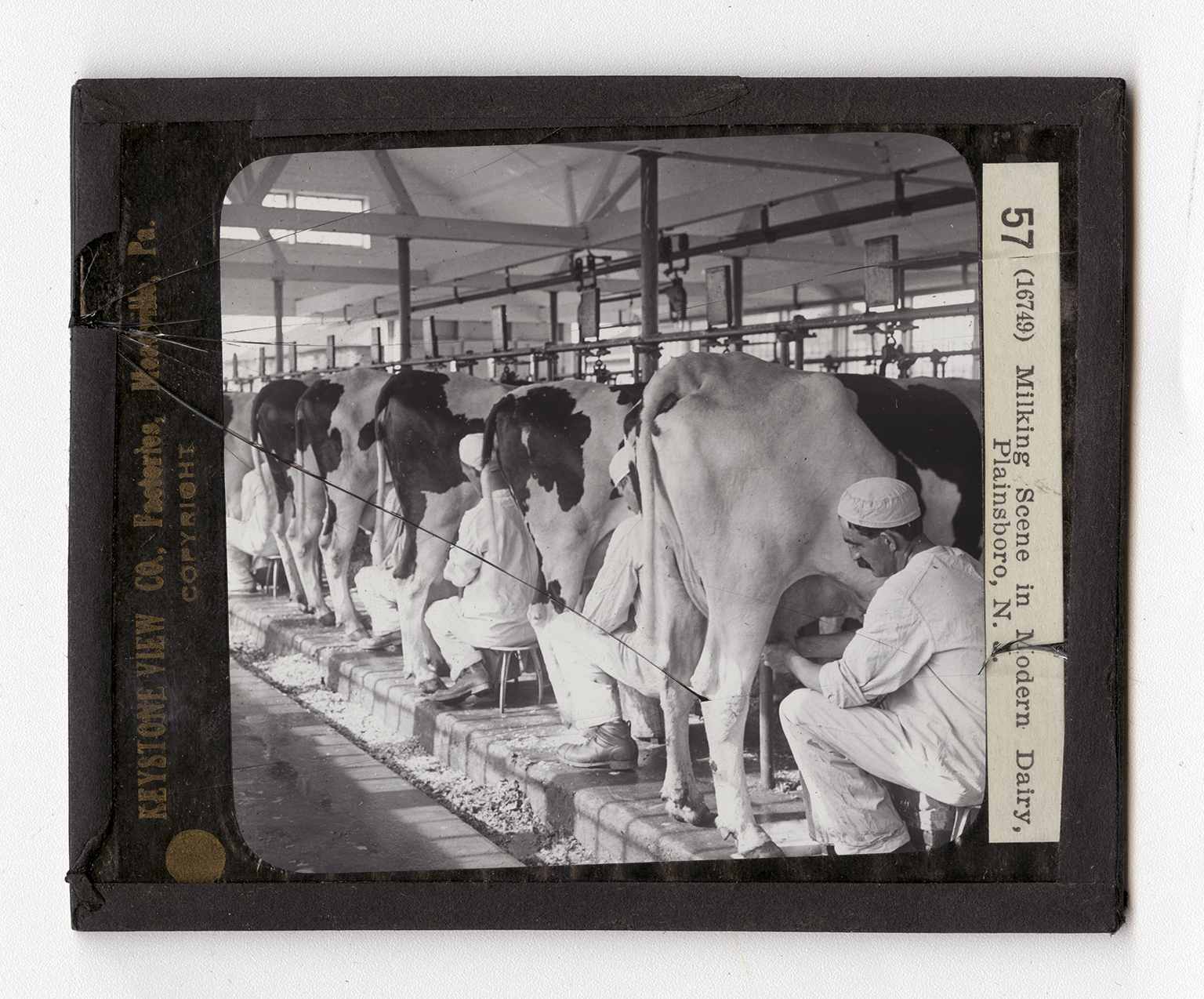
or the apartments at a stated price per pint or per quart. Cheaper milk in quantities, not bottled, can be had at milk stations. This view shows one of the processes in the operation of a large dairy farm. Here the cattle are fastened in stanchions and carefully washed or combed so that the milk may be clean. Each milkman dons a clean, white suit of clothes, washes his hands, and milks his assigned number of cows. You will observe how spick and span, airy, sunshiny, and light everything is kept in these modern dairy barns. Electric lights are installed and in some cases milking machines, instead of men, perform this part of the operation. The milk is shipped by fast freight to the milk stations of the dairy located in the city. Here it is bottled and distributed regularly to thousands of customers.