Negative Number: 6242
Latitude: 24.0
Longitude: 33.0
Geographical Classification:
Africa: Egypt
Card Front:
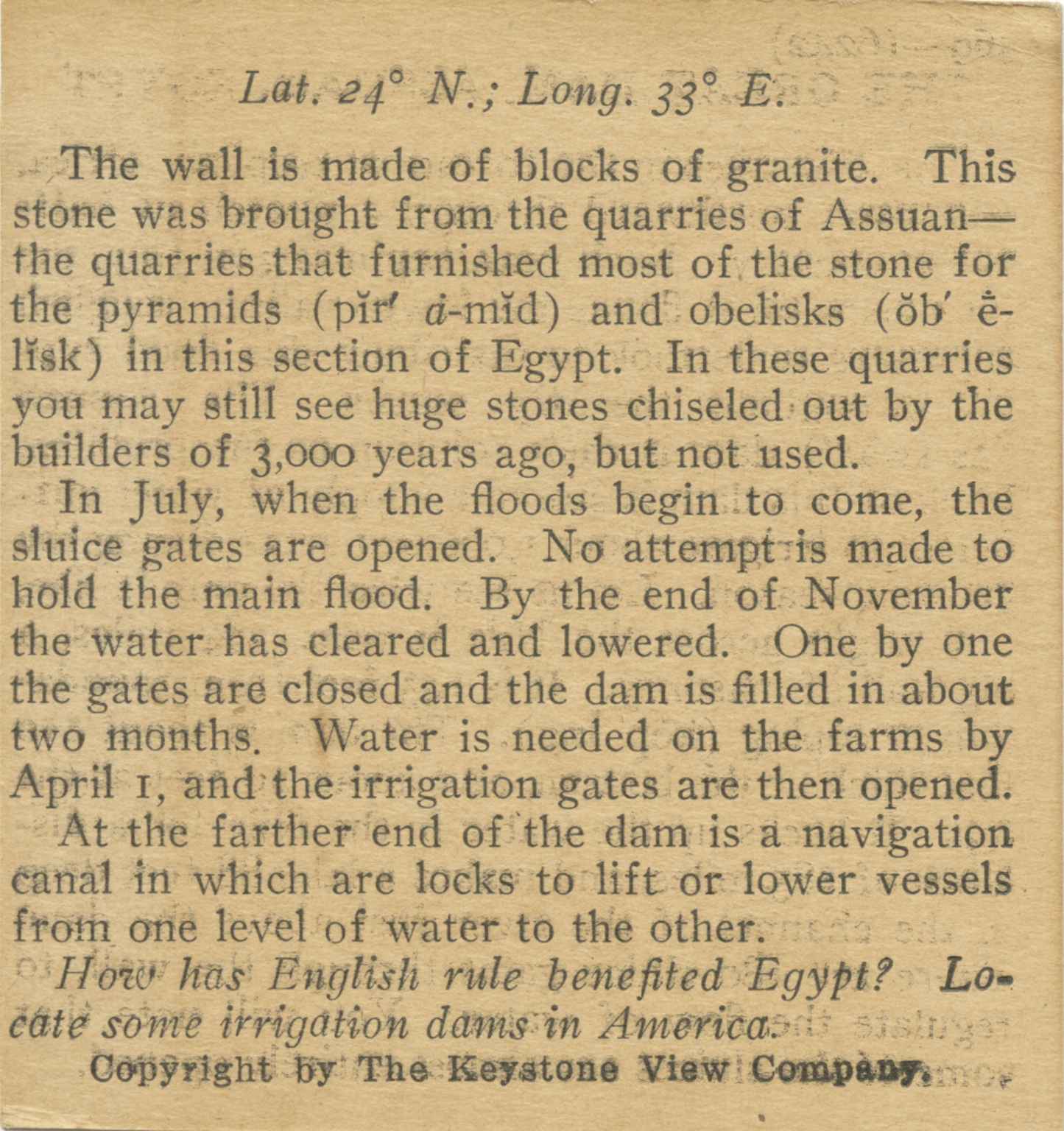
The Nile rises in the forests of tropical Africa, and flows northward through a stretch of half-desert country. Each year, beginning in July, the Nile rises till it floods the lower valley. English engineers undertook to distribute this flood supply throughout the dry season. The Assuan dam is their solution to the problem. Back of this dam is stored a supply of water sufficient to irrigate about 1,000,000 acres. during the growing season. Let us see what the dam is like. Straight across the Nile it runs, 1 1/4 miles, a big wall of masonry. It is 145 feet from foundation to coping. The dam is about 110 feet thick at the bottom, and about 40 feet at the top. It backs up the water in the Nile for a distance of 185 miles, and makes a lake 88 feet deep, in the channel of the river just above the dam. There are 180 sluice gates through the wall, to regulate the flow of the water. You will note that some of these sluices are almost entirely opened.
Card Back:
The wall is made of blocks of granite. This stone was brought from the quarries of Assuan- the quarries that furnished most of the stone for the pyramids and obelisks in this section of Egypt. In these quarries you may still see the huge stones chiseled out by the builders of 3,000 years ago, but not used. In July, when the floods begin to come, the sluice gates are opened. No attempt is made to hold the main flood. By the end of November the water has cleared and lowered. One by one the gates are closed and the dam is filled in about two months. Water is needed on the famrs by April 1, and the irrigation gates are then opened. At the farther end of the dam is a navigation canal in which are locks to lift or lower vessels from one level of water to the other. How has English rule benefited Egypt? Locate some irrigation dams in America.