Negative Number: 9843
Latitude: 25.0
Longitude: 23.0
Geographical Classification:
Africa: Egypt
Card Front:
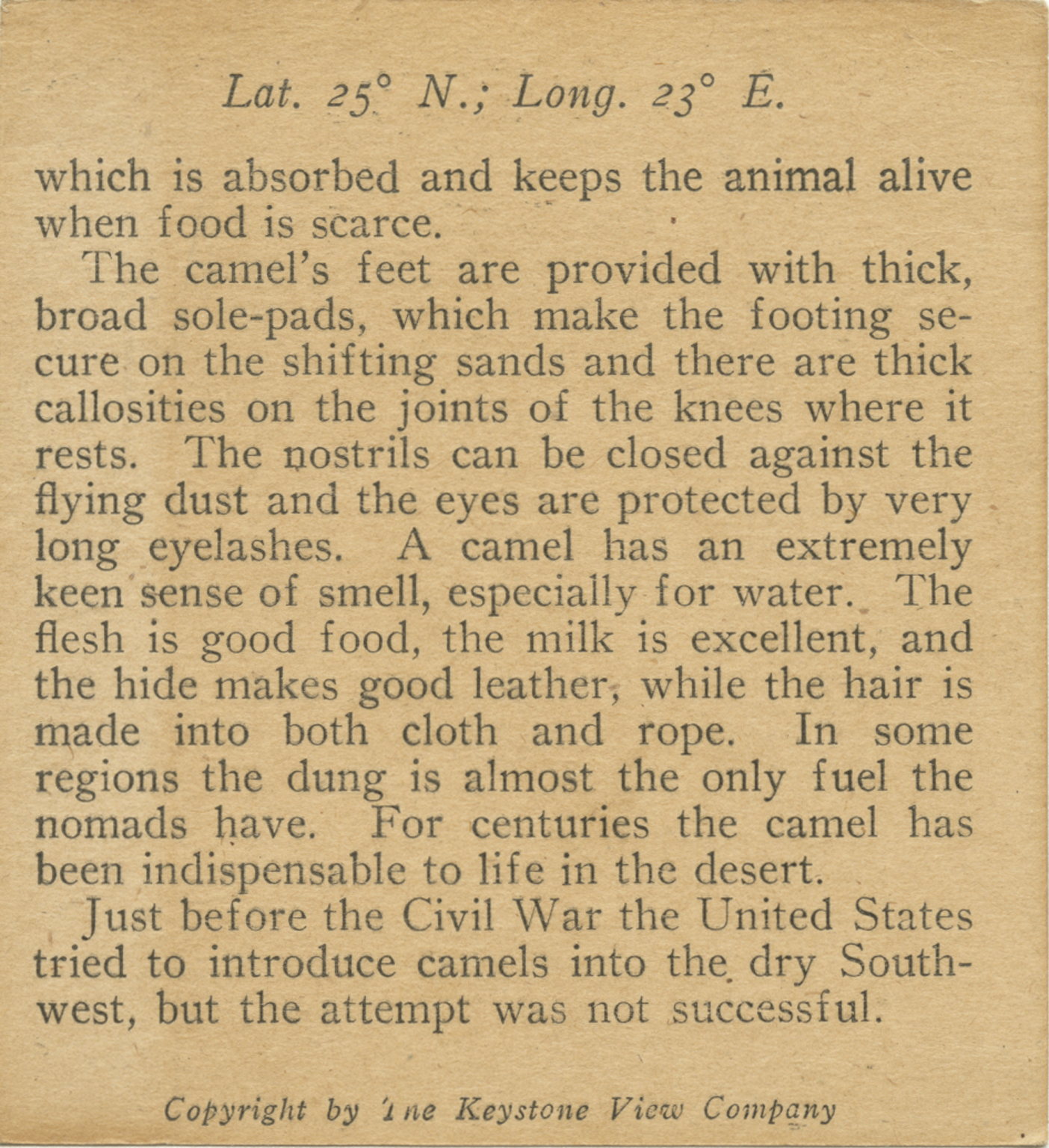
Almost all of the northern Africa is a desert. Much of it would be fertile if it has water, but as the prevailing winds come from the northeast from across Asia, they are dry and bring no rain. Wherever underground water comes to the surface, there is an oasis covered with luxuriant vegetation. Date palms flourish and furnish food for the people. People who live where water is plentiful can hardly imagine how it is prized and every drop conserved for use. These soldiers have rested and refreshed themselves in the oasis and are again starting off across the desert. They are in haste, for each man rides a dromedary, as the swiftest camels are called. The very best can carry a rider a hundred miles in a day. The ordinary camel cannot travel more than three days without drinking, but the better breed can go six or seven days without water and with very little food. The hump is made of fat
Card Back:
which is absorbed and keeps the animal alive when food is scarce. The camel's feet are provided with thick, bbroad sole-pads, which make the footing secure on the shifting sands and there are thick callosities on the joints of the knees where it rests. The nostrils can be closed against the flying dust and the eyes are protected by very long eyelashes. A camel has an extremely keen sense of smell, especially for water. The flesh is good food, the milk is excellent, and the hide makes good leather, while the hair is made into both cloth and rope. In some regions the dung is almost the only fuel the nomads have. For centuries the camel has been indispensable to life in the desert. Just before the Civil War the United States tried to introduce camels into the dry Southwest, but the attempt was not successful.