Negative Number: 10035
Latitude: 13.0
Longitude: 124.0
Geographical Classification:
Asia: East Indies: Philippines
Card Front:
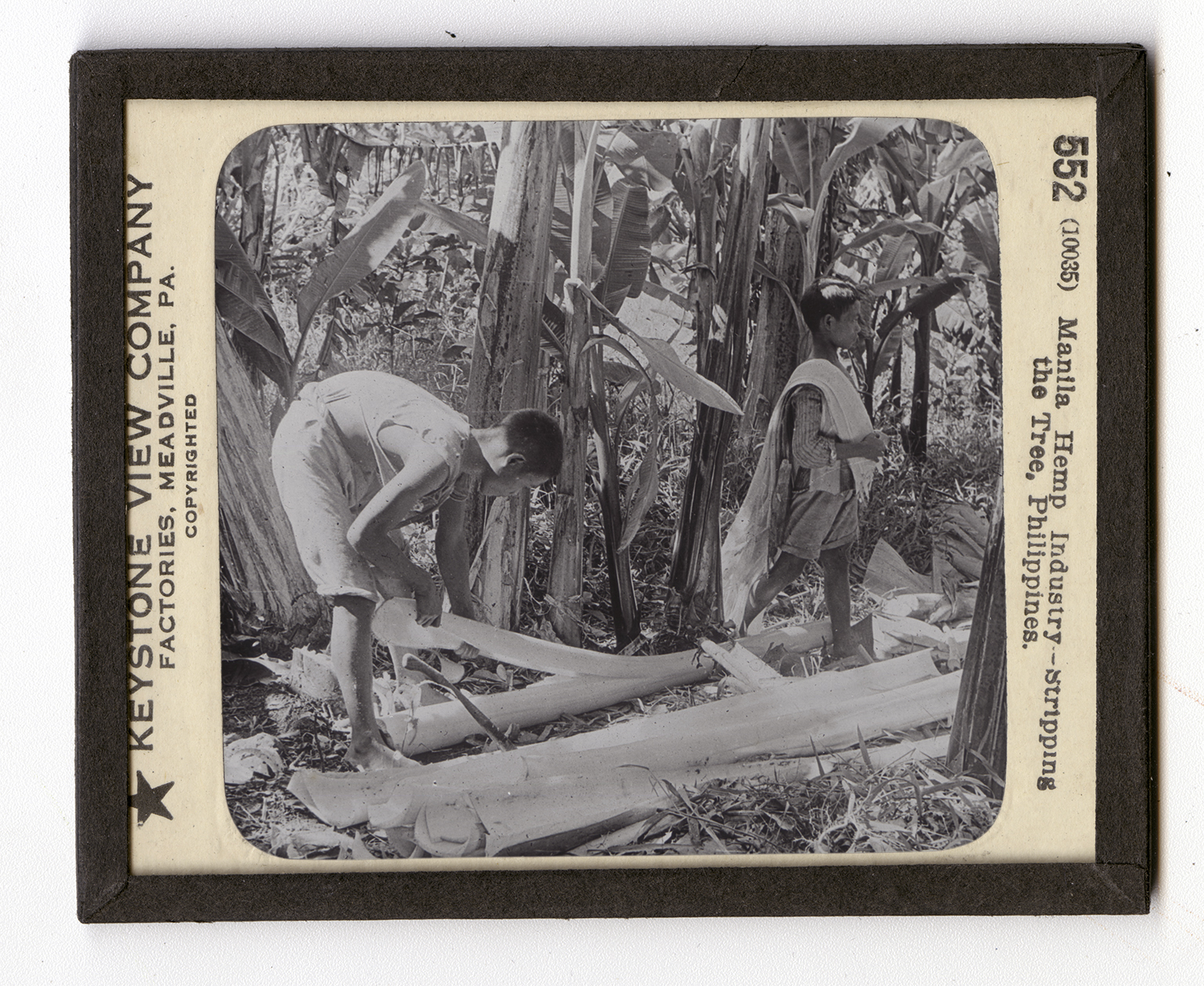
In the grain fields of our country, thousands of pounds of twine are needed each harvest to tie the bundles of wheat, oats, barley, and rye. Ropes are needed in ship building, construction work, hauling, farming, and other industries. Small cordage is needed every day in hundreds of ways. Twine, ropes, and string are made of fibers. The most important of these is obtained from a plant called henequen, or sisal hemp. Most of this fiber comes from Yucatan. The nest most important fiber comes from the Philippines. This is abaca, usually called Manila hemp. Abaca is obtained from a tree-like plantain or banana plant. There are 14 varieties of this plant. It looks much like the banana plant, but it is not so large and the leaves are narrower and darker in color. It grows to a height of about 70 feet. The hot, wet climate of the Philippines
Card Back:
is exactly suited to its growth. The plant is made up of layers, much like the layers of an onion. In the outside folds are the long, tough fibers - the abaca. The plant is first chopped down and its top lopped off, leaving a trunk that looks like a short pole. A piece of bone is run between the first and second layers. The outside layer is pulled off at one stripping. Then the next layer, and so on. The strips are called bast. A machine scrapes off the pulp, leaving the fibers free. The fibers are put into drying sheds, or cured on poles in the open, and are later shipped in bundles. Some of the fibers are 8 to 10 feet long. Each plant yields about 1/2 pounds of dried fiber. About $20,000,000 worth of abaca is exported from the Philippines each year. Some of the hemp is also made into sailcloth, laces, and hat braids.