Negative Number: 10070
Latitude: 15.0
Longitude: 121.0
Geographical Classification:
Asia: East Indies: Philippines
Card Front:
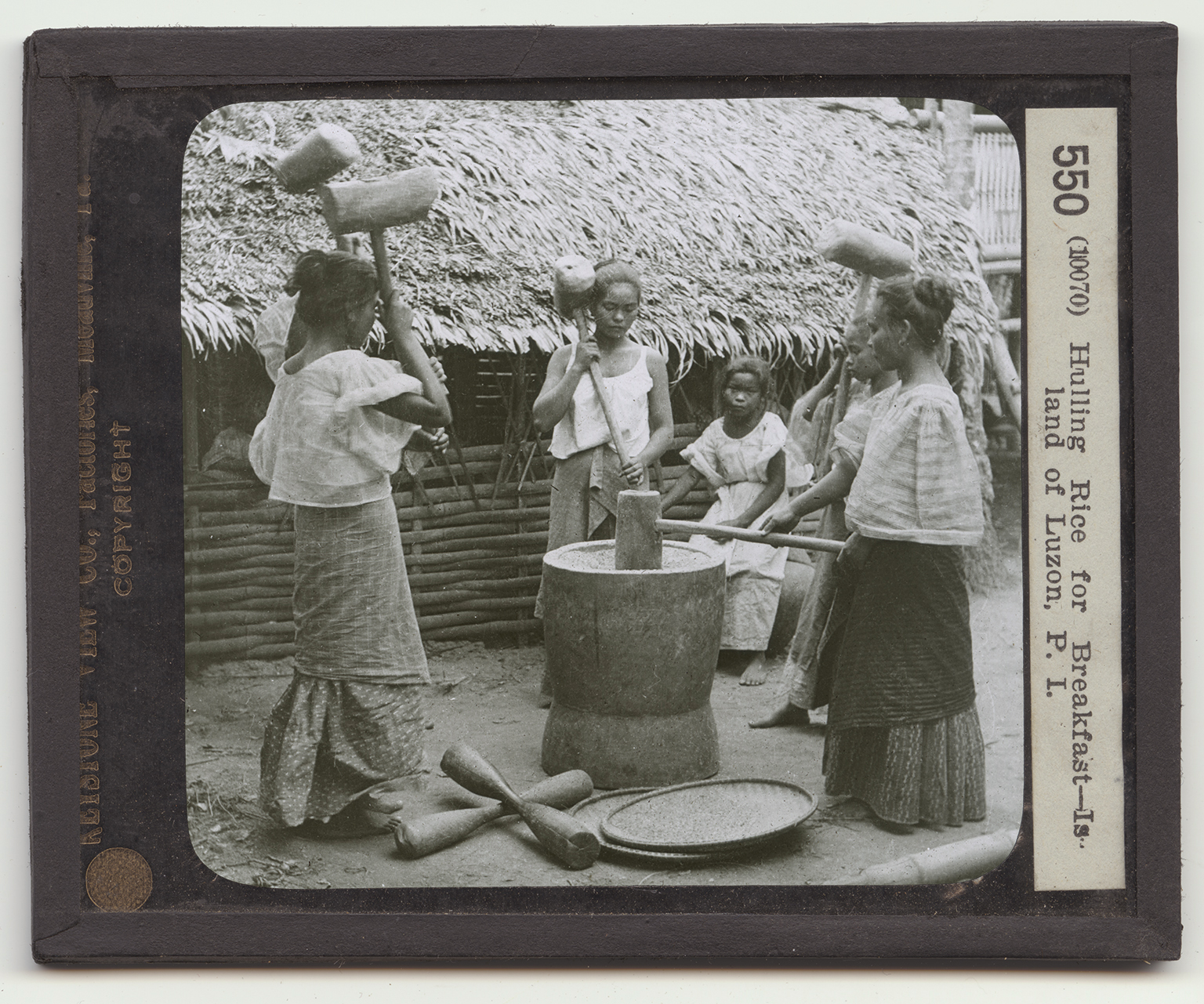
After the rice has been harvested, it is stores in bundles, in or near the farmers house. It is hulled as it is needed, day by day. The usual hulling time is evening, and the work is done mostly by the girls. And a queer method it is that these girls use. If you were to come near a cluster of Philipine country houses in the evening you would hear a regular boom! boom! boom! You might think that heavy guns had opened up a bombarment. In fact, American officers once heard such a booming and they led their soldiers forth to take part in battle. What they found is what you see here. Filipino girls were hulling rice for the next day! The heads of the rice are placed in a large, hollowed-out block of wood. Around this assemble 4 or 5 girls, each with a heavy mallet. Boom! goes the mallet of the first. She lifts the maul out, and the second strikes. Round the cir-
Card Back:
cle the beating goes as regularly as pulse beats. Sometimes clubs are used instead, of mallets. Two of these are lying by the block. These are hurled down end-wise the right hand grasping the slender middle. They are picked up by the left hand. The regularity of the beating with the clubs is often timed by a musician thrumming on a guitar. Sometimes a young man helps the girls. This means that he is engaged to marry one of them. It is expected that a man about to marry will help his betrothed hull the rice. After the wedding, he is not required to perform this duty. Rice is served at every meal in a Filipino home. It is generally boiled, and served dry. There are two chief kinds of rice grown - white and red. The grain is so widely used that the country cannot grow enough for itself. Every year several million dollars' worth is imported.