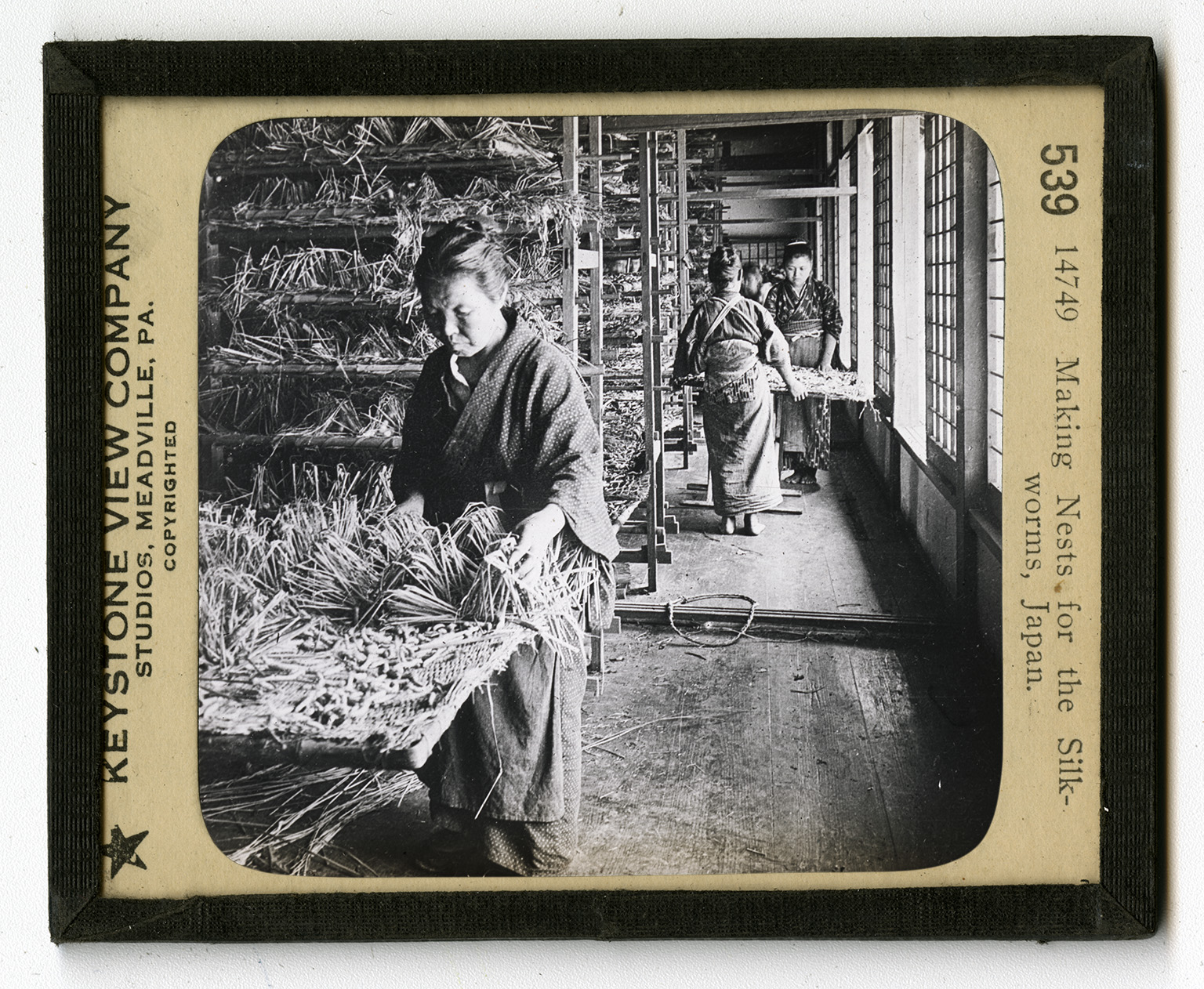
Negative Number: 14749
Latitude:
Longitude:
Geographical Classification:
Asia: Japanese Empire: Japan Proper
Card Front:
The third stage in the life of silkworms is the chrysalis or cocoon period. When the worms have become fully grown they refuse to eat. They are restless, and look about for a corner in which to spin their cocoons. Straw or light brush is put over the trays in which the worms live. The worms then begin spinning. On each side of their heads are two openings. Out of these a sticky fluid is thrown in two hair like fibers. The worms move their heads back and fourth so that both fibers are joined. The first tiny threads are fastened to the straw or brush to hold the cocoon in place. Then the worms begin spinning the cocoon about themselves. While the spinning is going on, the room housing the silkworms must be kept very quiet. If there should be any unusual noise or smell in the place, the worms would quit work. An
Card Back:
overseer can tell at once when the spinning stops. While working, the worms make a soft noise like purring. Tens of thousands of them in a room make a noise like smoothly running machinery a long distance away. In a few days the cocoons are spun. The cocoons are left for about a week before they are gathered up. A few are chosen to be hatched into moths. These moths will lay the eggs for the worms of the next year. Most of the cocoons are heated to destroy all life. The silk is then reeled off the cocoons. The thread of many damp cocoons are wound together in a single strand. The thread of one large cocoon is from a fourth to a third of a mile in lenght. The size of the thread depends on the number of cocoons used. Sometimes the threads of 5 or 6 cocoons are wound together, sometimes 15 or 20. These new threads, folded in skeins, are sold as raw silk.