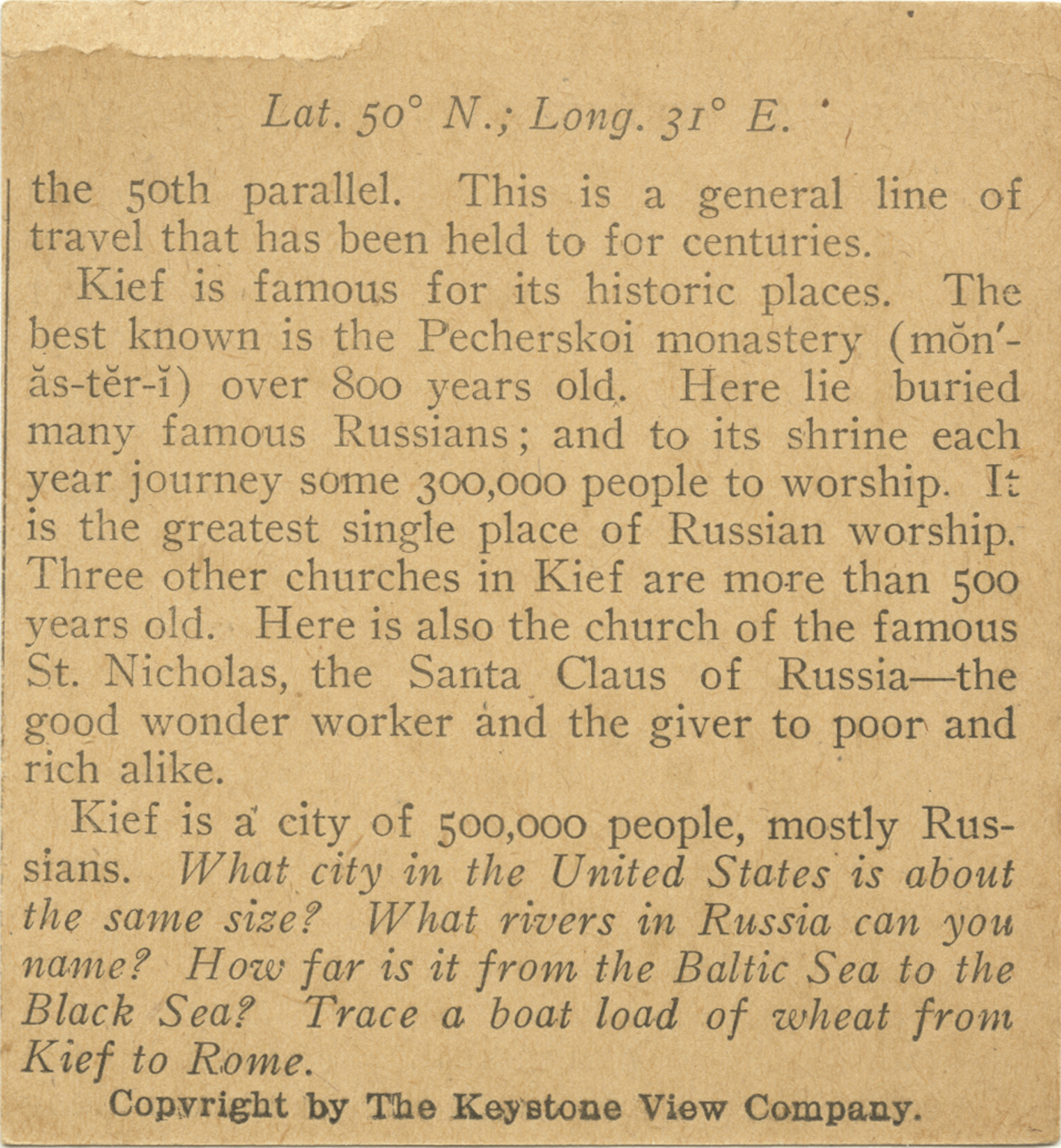
Negative Number: 18104
Latitude: 50.0
Longitude: 31.0
Geographical Classification:
Europe: Russia in Europe
Card Front:
Six hundred fifty miles due south of Petrograd is Kief. It is 275 miles due north of Odessa. It is on the Dnieper River, and in the "black earth" district. This name is given to the area north of the Black Sea on account of its rich soil. It follows that Kief is a center of exchange for agriculture products. Grains, fruits, sugar beets, hemp, flax, tobacco, and cattle are raised. In the city the chief factories deal with sugar and tobacco. Kief is the center of the sugar production of Russia. There are flour mills, breweries, machine shops, gingerbread factories, and chemical works. One branch of the Dnieper is now linked with the Vistula River so that trade is carried over this route through Warsaw to Danzig, Germany, on the Baltic Sea. The Dnieper flows into the Black Sea. This gives Kief a double outlet for its products. It is also on the "West-to-East" route which runs generally along
Card Back:
the 50th parallel. This is a general line of travel that has been held to for centuries. Kief is famous for its historic places. The best known is the Pecherskoi monastery over 800 years old. Here lie buried many famous Russians; and to its shrine each year journey some 300,000 people to worship. It is the greatest single place of Russian worship. Three other churches in Kief are more than 500 years old. Here is also the church of the famous St. Nicholas, the Santa Claus of Russia - the good wonder worker and the giver to poor and rich alike. Kief is a city of 500,000 people, mostly Russians. What city in the United States is about the same size? What rivers in Russia can you name? How far is it from the Baltic Sea to the Black Sea? Trace a boat load of wheat from Kief to Rome.