Negative Number: 15687
Latitude:
Longitude:
Geographical Classification:
Europe: Austria-Hungary
Card Front:
Hungary as a part of the Austro-Hungarian Empire was subordinated in many ways to Austria. Budapest suffered by comparison with Vienna. Now as an independent country, the indications are that is has days of prosperity and happiness in sight once more, and greater liberties as well. Hungary is an agriculture country. Its principal crops are corn, wheat, barley, oats and rye. Grapes are widely grown. Tobacco and hops are important field crops. Its orchards produce apples, apricots, peaches, pears and plums. Its forests are extensive. The mines and factories of Hungary are its other sources of wealth. Iron, coal, gold and silver are the chief minerals. It manufactures clothing, food-stuffs, machinery, glassware, leather, chemicals, suagr, and flour.
Card Back:
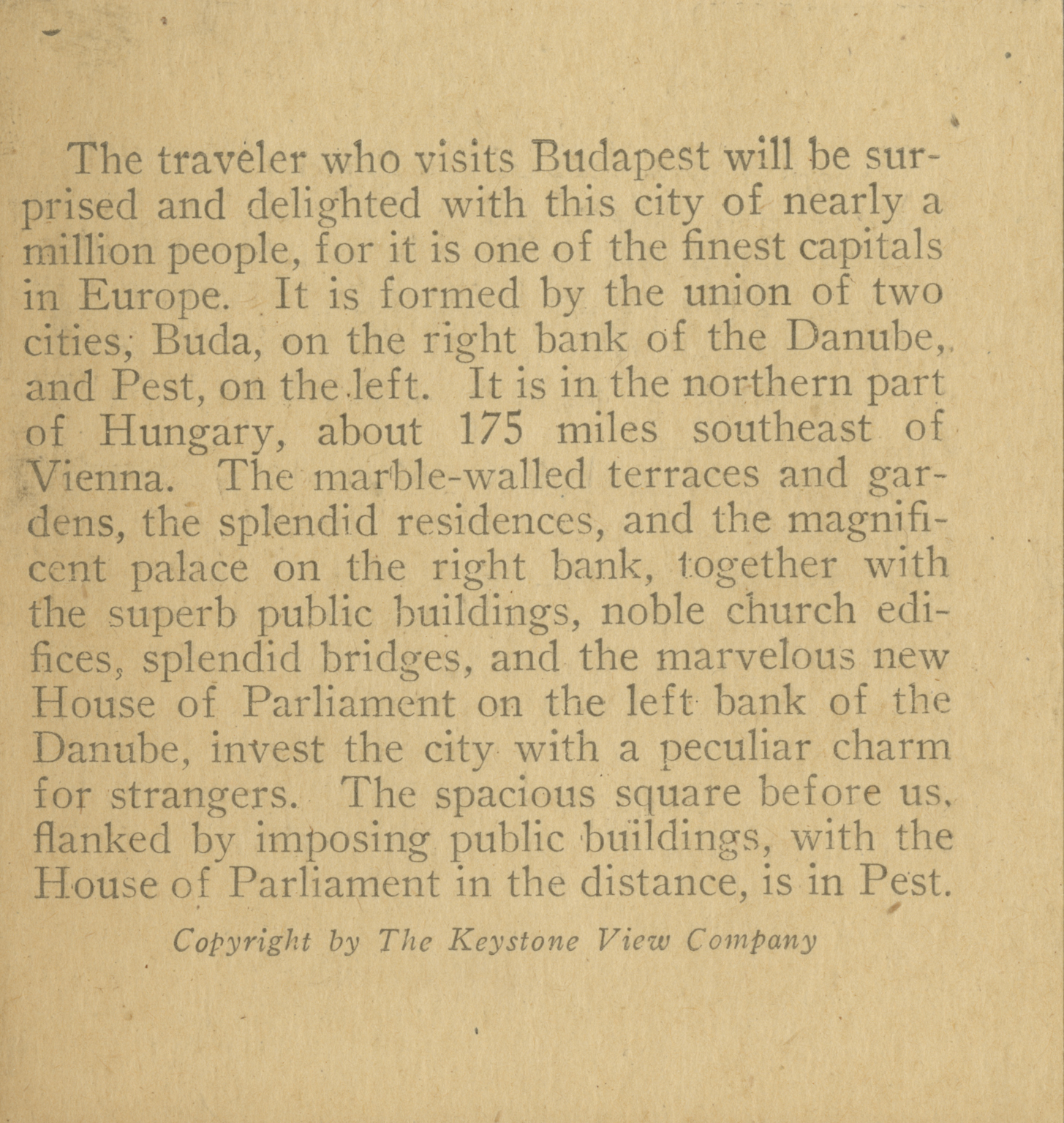
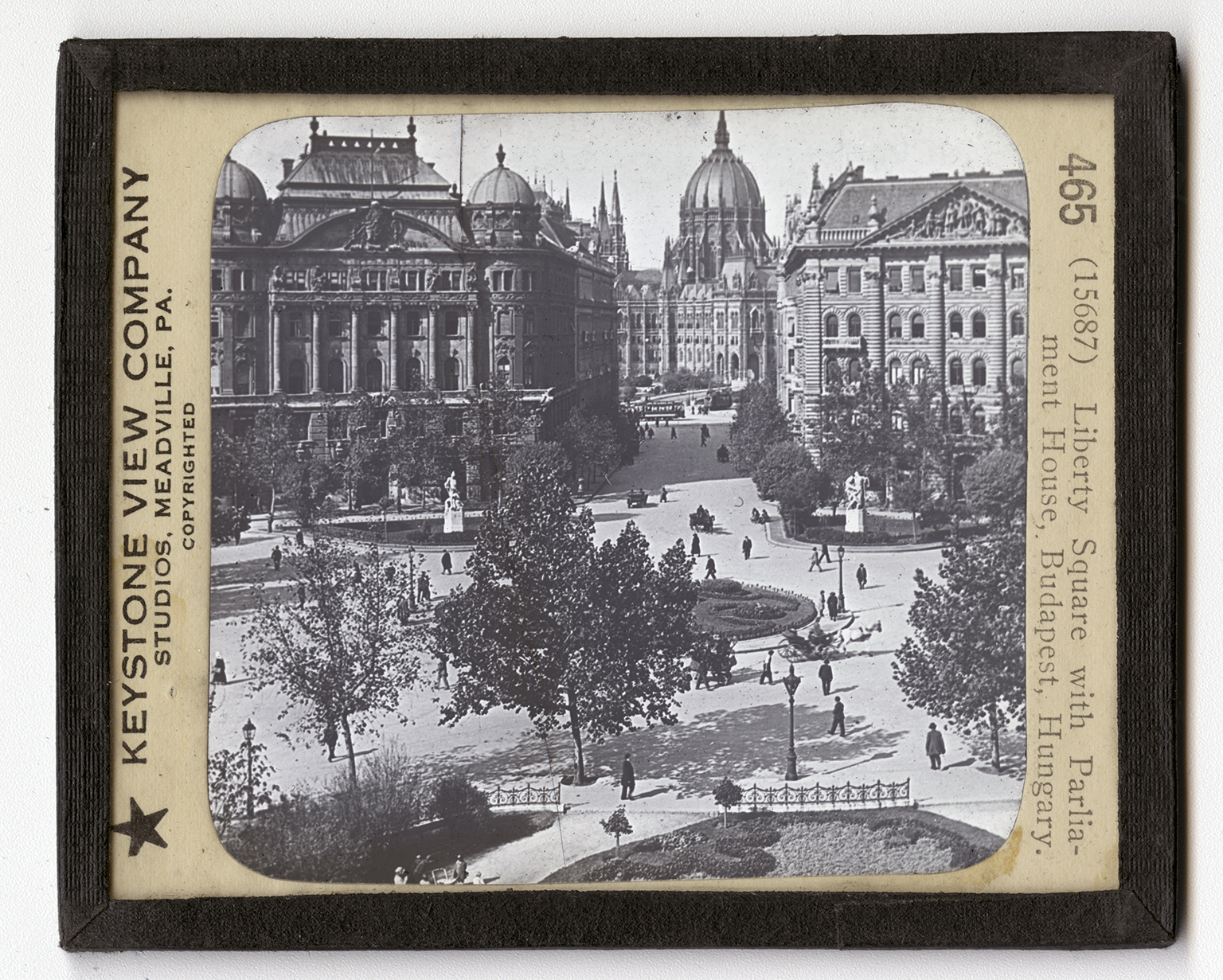
The traveler who visits Budapest will be surprised and delighted with this city of nearly a million people, for it is one of the finest capitals in Europe. It is formed by the union of two cities, Buda, on the right bank of the Dunabe, and Pest, on the left. It is in the northern part of Hungary, about 175 miles southeast of Vienna. The marble-walled terraces and gardens, the splendid residences, and the magnificent palace on the right bank, together with the superb public buildings, noble church edifices, splendid bridges, and the marvelous new House of Parliament on the left bank of the Danube, invest the city with a peculiar charm for strangers. The spacious square before us, flanked by imposing public buildings, with the House of Parliament in the distance is in Pest.