Negative Number: 16750
Latitude: 42.0
Longitude: 78.0
Geographical Classification:
North America: United States and Possessions (Except Asiatic Possessions): Middle Atlantic States: New York
Card Front:
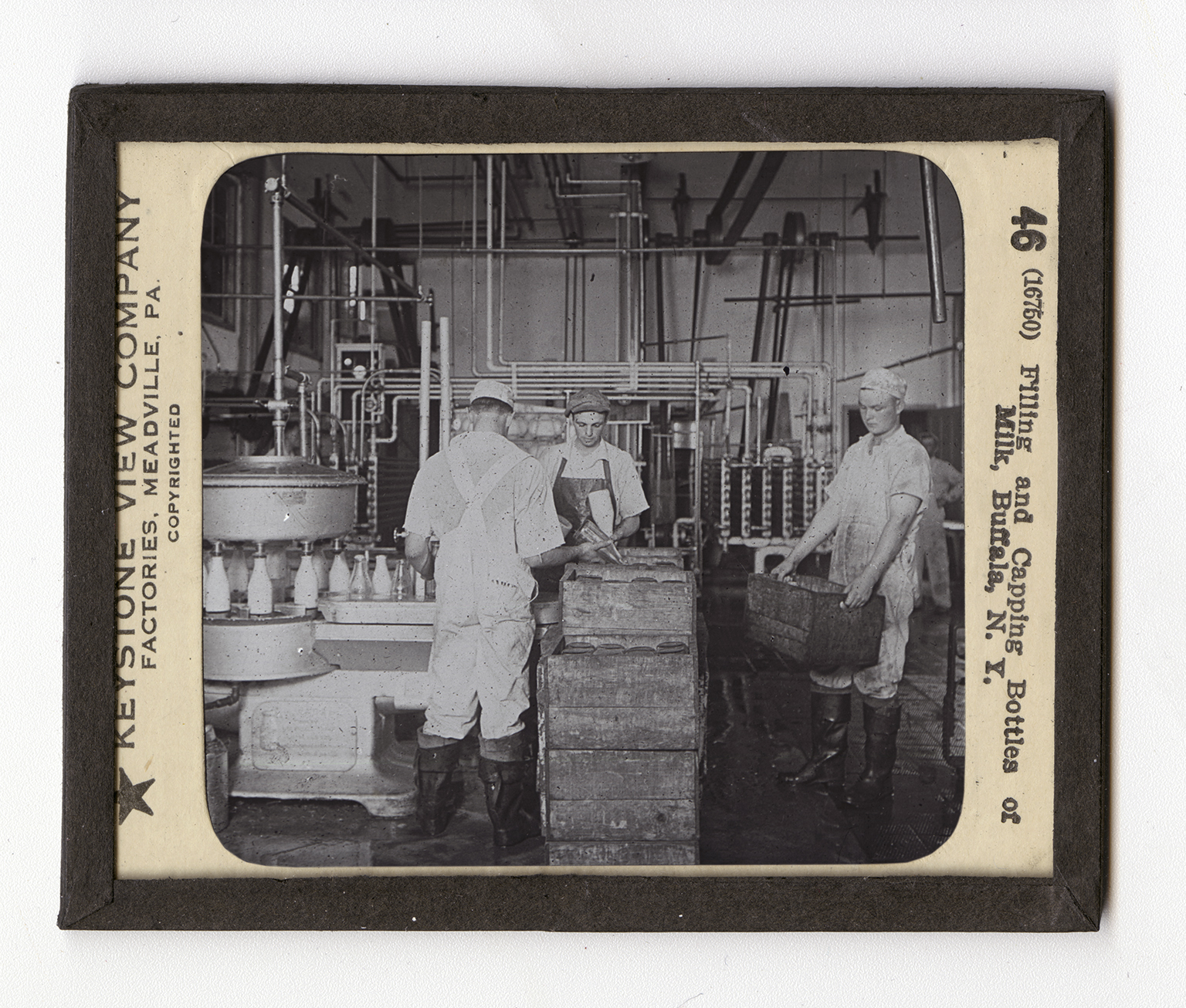
From the great dairy farms milk is generally shipped to cities in cans. In some cases, however, it is bottled at the dairy before shipment. In either case the processes of handling it are the same. The fast freight trains called milk trains carry the product of the dairy to large cities over all the leading railway lines. A great many of the dairy farms are within a radius of from 10 to 25 miles of the city which they supply; but many of them are much farther away. Some of the milk trains that run daily carry milk as far as 150 miles. The time of milking the cows must be arranged so that the canned or bottled milk can be loaded on these trains. Milk cannot be carried over in the dairy from day to day. It must be fresh. When the cans reach the city they are loaded in trucks and carried to the dairy's distributing
Card Back:
station. Here the milk is put into bottles after the fashion shown in the view. The machine you see makes it unnecessary for the milk to be handled by the workmen. This is a saving in expense, but far better, it insures cleanliness. Milk must be kept clean. It is a good carrier of disease, especially of typhoid fever. The milk is poured from the receiving vat into which the cans are emptied, to the automatic filler and capper. The empty bottles, after they have been washed in boiling water, are set on an endless belt. This carries them under the faucets of the filling machine where each bottle is filled with exactly the proper amount, and capped with a pasteboard lid. Each bottle is labeled with the date of its bottling. This is an added protection to the buyer.