Negative Number: 13422
Latitude: 60.0
Longitude: 4.0
Geographical Classification:
Europe: Norway
Card Front:
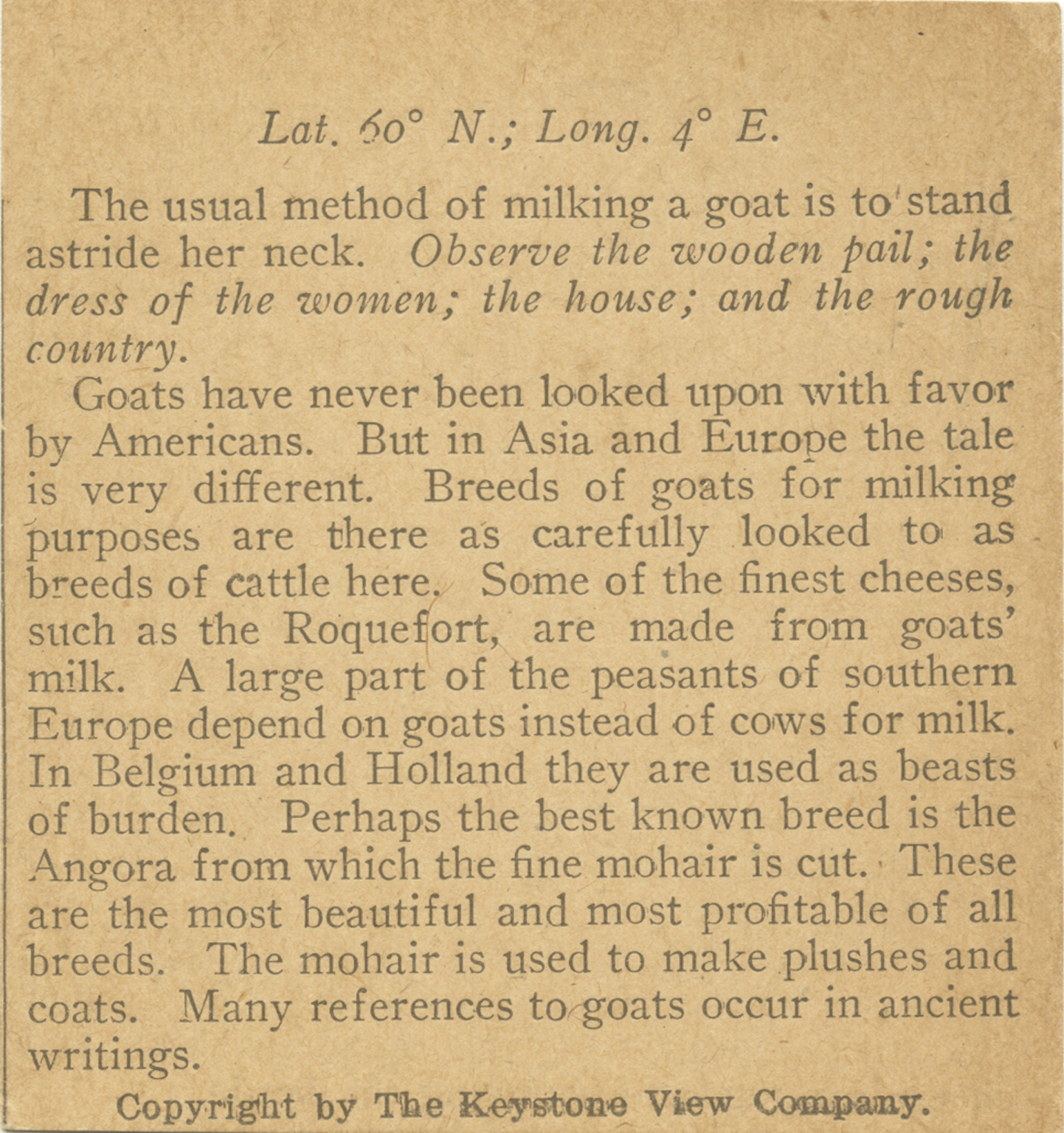
This is a summer morning's scene in the heart of Norway. Most of the land of this north country is too rough to till. But the rocky parts grow grass that will keep herds of cattle and goats. For this reason most famrs have a grazing district and a dairy miles away to which the herds are driven in the early spring. While the farmer boys are tilling the level fields about the house, the girls drive the cattle and the goats to the hills. Farther and farther they go up the slopes as the snows retreat in the summer. It is the front of one of these summer homes or dairies that you see pictured. The goats are milked in the early morning and are then driven to the pastures. They can graze on hills too rough for the cattle to go. When the long evening twilight comes they stroll back to the lot by the house for the evening milking. The women busy themselves during the day with butter and cheese making, and watching the herds.
Card Back:
The usual method of milking a goat is to stand astride her neck. Observe the wooden pail; the dress of the women; the house; and the rough country. Goats have never been looked upon with favor by Americans. But in Asia and Europe the tale is very different. Breeds of goats for milking purposes are there as carefully looked to as breeds of cattle here. Some of the finest cheeses such as the Roquefort, are made from goats' milk. A large part of the peasants of southern Europe depend on goats instead of cows for milk. In Belgium and Holland they are used as beasts of burden. Perhaps the best known breed is the Angora from which the fine mohair is cut. These are the most beautiful and most profitable of all breeds. The mohair is used to make plushes and coats. Many references to goats occur in ancient writings.