Negative Number: 10376
Latitude: 49.0
Longitude: 11.0
Geographical Classification:
Europe: German Empire
Card Front:
Bavaria is one of the important provinces of the German Empire. It is made up of two provinces, one of which is Bavaria proper, and the other the Palatinate (pa-lat' i-nat). The latter lies west of the River Rhine, while Bavaria lies east of it and centers about the upper Danube. The two provinces comprise about 29,000 square miles of territory with a population of about 7,000,000. Bavaria stands first among the German states in agriculture. Its most important crops are barley and hops, both of which are used extensively in making liquours. Its vineyards cover some 60,000 acres, with an annual output of some 12,000,000 gallons of wine. Next to its agricultural production comes stock raising. There are fine herds of cattle throughout Bavaria, and it is because of this the hay crop is very important.
Card Back:
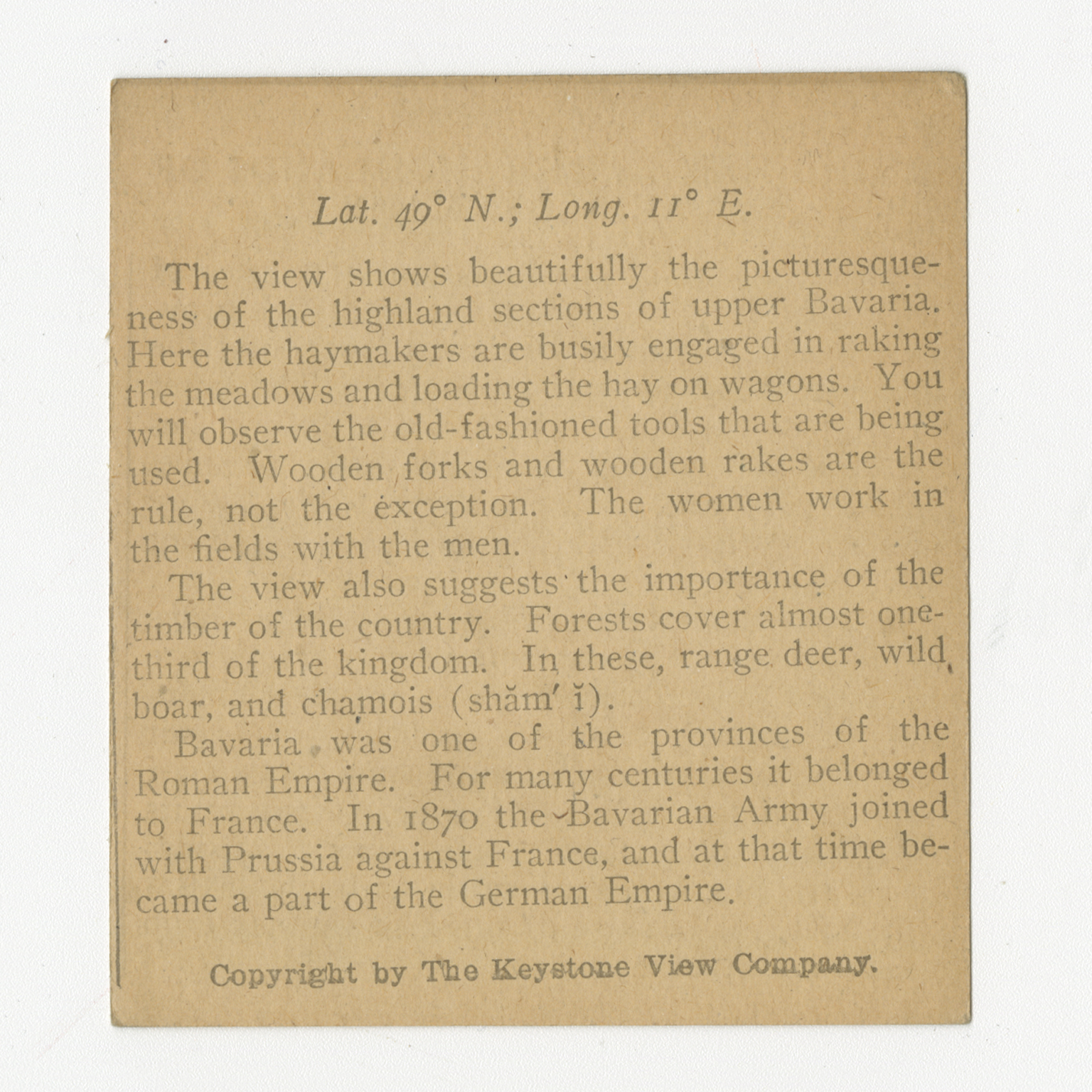
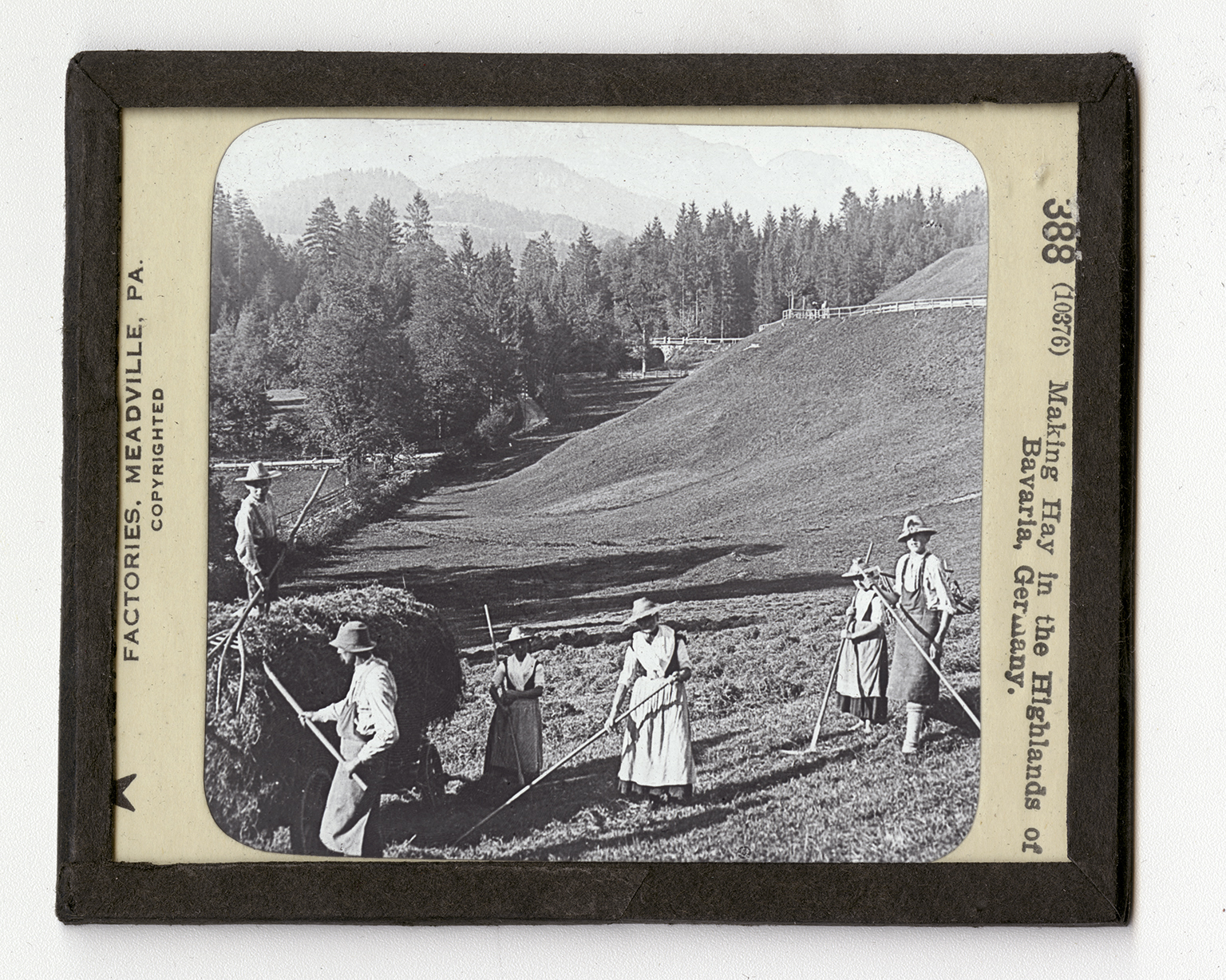
The view shows beautifully the picturesqueness and the highland sections of upper Bavaria. Here the haymakers are busily engaged in raking the meadows and loading the hay on wagons. You will observe the old-fashioned tools that are being used. Wooden forks and wooden rakes are the rule, and the exception. The women work in the fields with the men. The view also suggests the important of the timber of the country. Forests cover almost one-third of the kingdom. In these, range deer, wild boar, and chamois (sham i'). Bavaria was one of the provinces of the Roman Empire. For many centuries it belonged to France. In 1870 the Bavarian Army joined with Prussia against France, and at that time became a part of the German Empire.