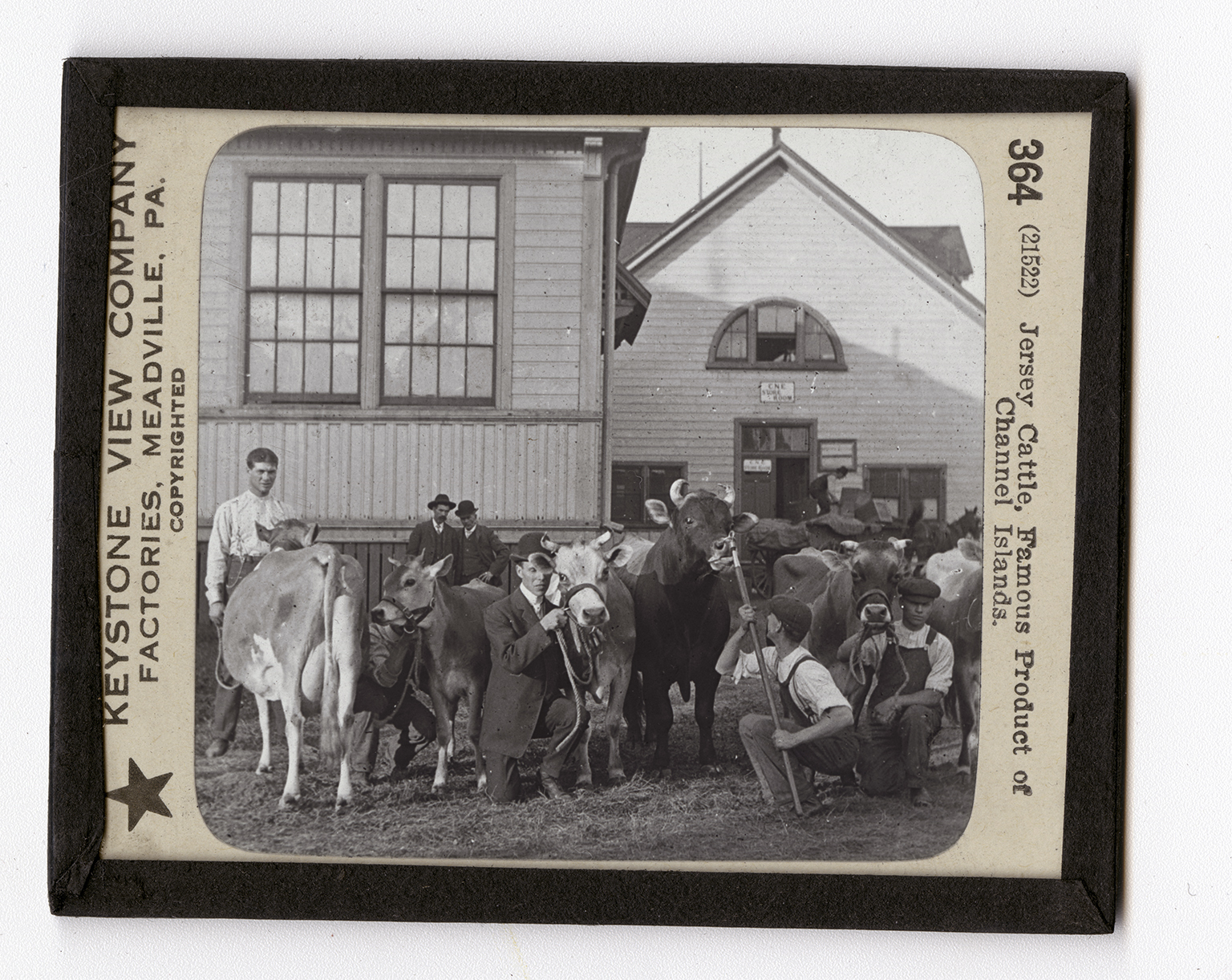
Negative Number: 21522
Latitude: 49.0
Longitude: 2.0
Geographical Classification:
Europe: Great Britain: Channel Islands
Card Front:
The island of Jersey in the English Channel is only 10 miles long and 6 miles broad. But this little strip of land has made itself famous because of a breed of cattle it has developed. These are the Jerseys, a breed that leads all others as producers of milk rich in butter fat. The ancestors of the Jersey were probably brought to the island from Normandy, France. At any rate by 1700 Jersey was already famed for its cattle. The breed is most carefully protected. No other cattle can be brought into Jersey except for butchering purposes. The blood of the stock is pure, and has been kept free from other strains for a long time. On the island, grass grows luxuriantly and the cattle are tethered in the open field in daytime from May to October. At night they are warmly housed. Jersey cattle are easy to pick out from other breeds. Their fawn-like color, slender limbs, broad muzzles, bright eyes, high hips, and large
Card Back:
udders are noticable. They are not a beef cattle but a dairy breed, and are raised particularly for butter products. Some of the cows give as much as 10,000 pounds of milk in one year. At the fair in St. Louis in 1904, 25 cows were tested for 120 days. The total amount of their milk was 124,524 pounds or 6841 pounds of butter. That is, each cow averaged 2.3 pounds of butter daily. The breed is now common in many countries. The United States, Canada, France, England, New Zealand, and Australia, all have large herds. The breeding of these cattle is now in the direction of more and richer milk, and shapely bodies. This is a prize herd of Jerseys - 5 females and 1 male. You can readily pick out the features of the breed. How do Jerseys differ from Holstein-Friesians? From Herefords? Locate the island of Jersey. What kind of climate does it have?