Negative Number: 21866
Latitude: 16.0
Longitude: 70.0
Geographical Classification:
South America: Bolivia
Card Front:
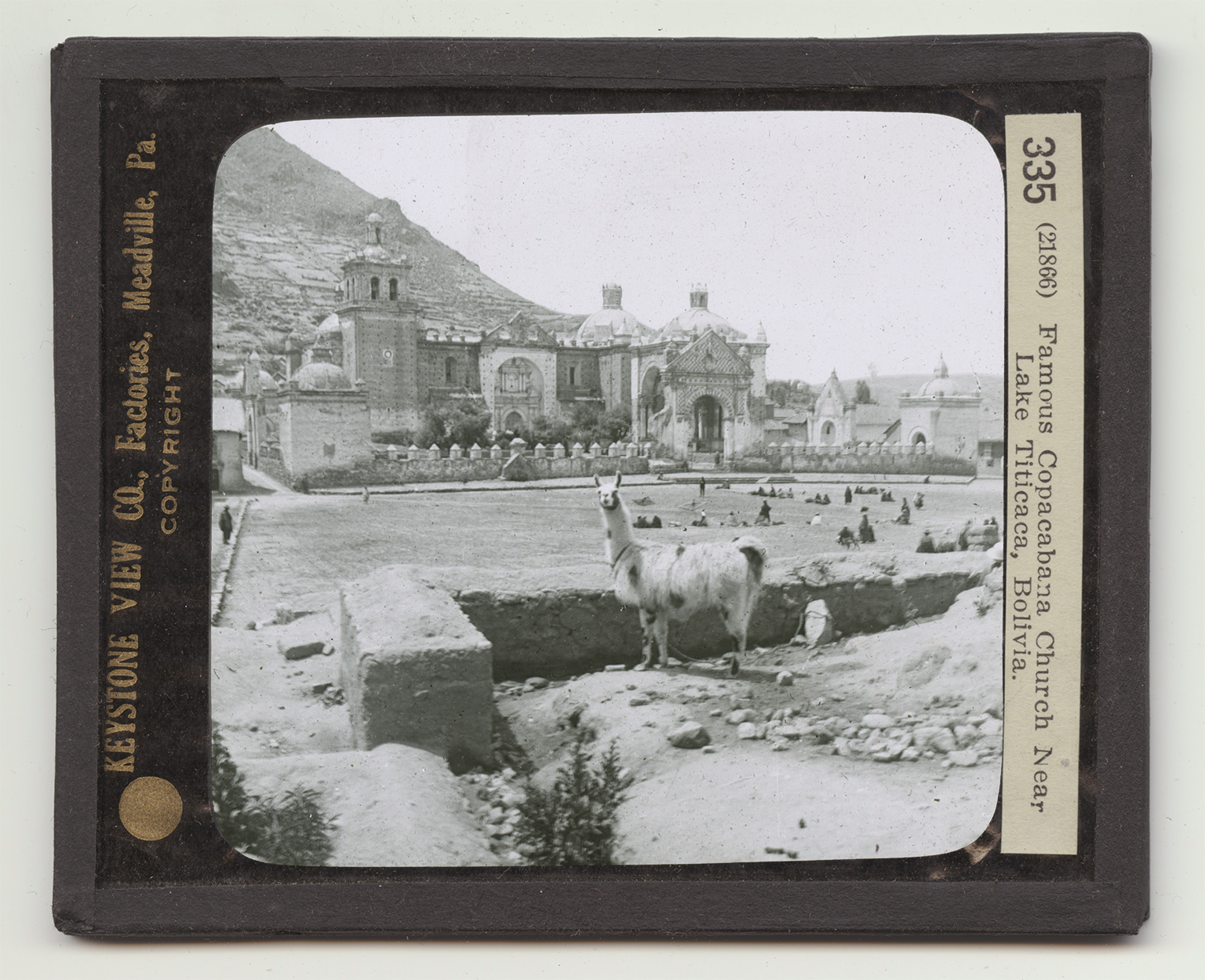
South America is rich in its beautiful cathedrals and churches. Of especial interest are those in Peru and Bolivia. The one at Copacabana is of interest because of its style of building and because of its location. If you did not know otherwise, you might guess that the church is in India, Egypt, Spain, or Southern California. It looks somewhat like a Moorish temple with the finishing touches of the mission churches common to California and Mexico. It is built near the ruins of an old, old civilization; for here thrived the Incas, and the tribe of people that lived here before the Incas came. It is close to Lake Titicaca. This lake lies from northwest to southeast. Its southern end is indented by a point of land, and on this the city of Copacabana is built. Lake Titicaca is the highest lake in the world. It is also the largest lake in South America. It lies
Card Back:
in an elevated valley in the Andes, and forms a part of the boundary line between Peru and Bolivia. It lies 13,860 feet above the sea level and parts of it are almost 1000 feet deep. It is roughly 130 miles long by 35 miles wide, and has an area of 4000 square miles. In the foreground you see a llama. It belongs to the camel family. Its color is usually white, but it sometimes had brown or black spots on it, and occasionally a brown or black spots on it, and occasionally a brown or black one is seen. It is the principal pack animal in the mountains of Peru and Bolivia. It is as sure of foot as a goat. Yet large enough to carry a load of 100 lbs. If it is too heavily loaded it will kneel down and refuse to move until part of the burden is removed. Great trains of them carry ore from the mines to the coast, and bring back loads of manufactured goods.