Negative Number: 21836
Latitude: 33.0
Longitude: 72.0
Geographical Classification:
South America: Chile
Card Front:
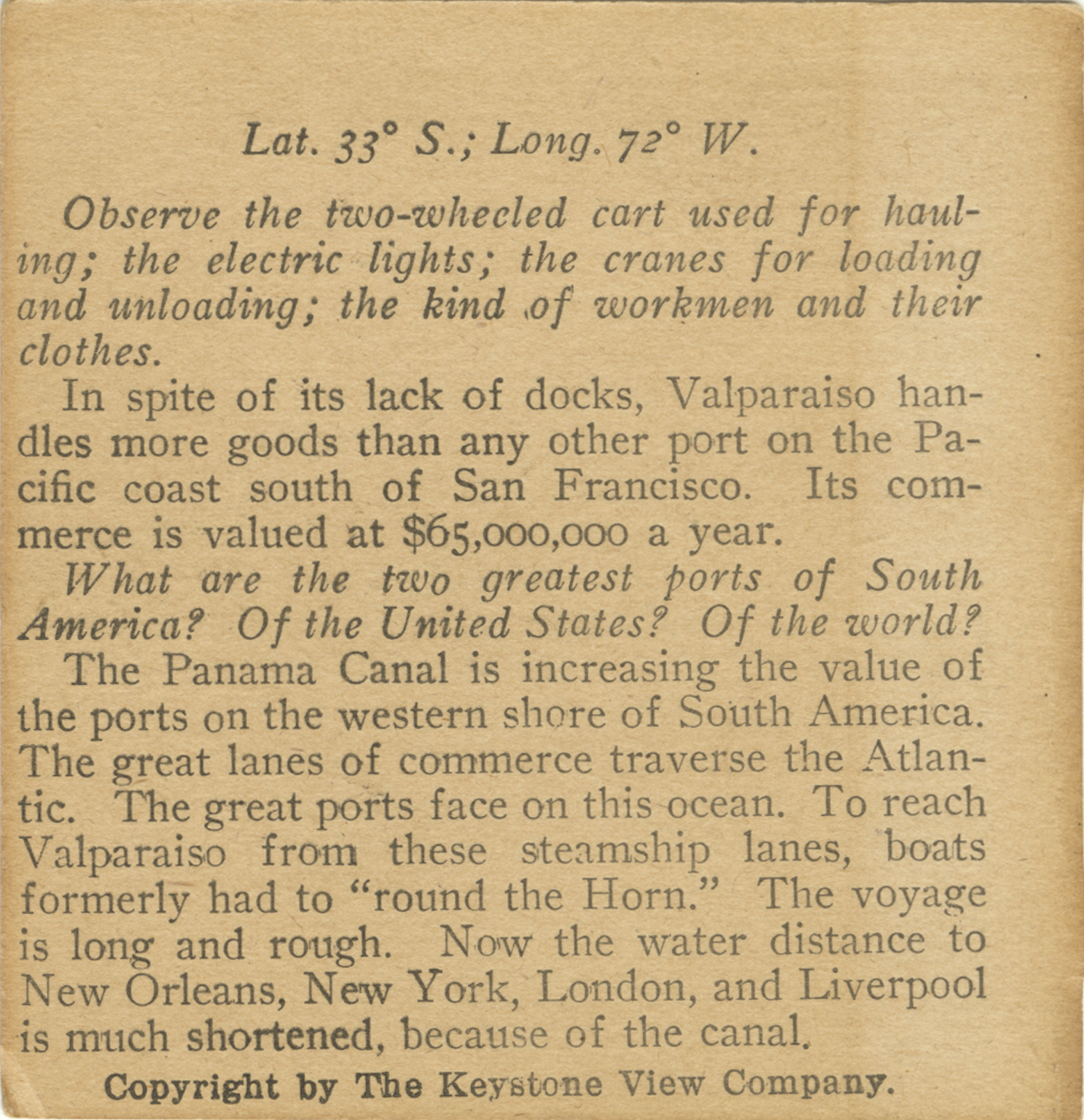
The harbor of Valparaiso could shelter all the navies of the world. But its docks are hardly large enough to handle the goods that must go through them from day to day. One does not see here the great docks one sees in the harbors of New York or London or Liverpool. Much of the loading and unloading of vessels takes place through lighters - the great ships lying out a distance from shore. This makes transportation slower and more costly than if the vessel could be loaded directly from warehouses on docks. Improvement in this line is slow because of lack of room. The business part of the city crowds down on the shore so closely that it shoves the shipping off. And the business section cannot be moved back from the water unless the high hills could also be pushed back. However, in time there will be great floating docks, or docks on "made land"; that is a strip of the bat will be fitted in to give room.
Card Back:
Observe the two-wheeled cart used for hauling; the electric lights; the cranes for loading and unloading; the kind of workmen and their clothes. In spite of its lack of docks, Valparaiso handles more goods than any other port on the Pacific coast south of San Francisco. Its commerce is valued at $65,000,000 a year. What are the two greatest ports of South America? Of the United States? Of the world? The Panama Canal is increasing the value of the ports on the western shore of South America. The great lanes of commerce traverse the Atlantic. The great ports face on this ocean. To reach Valparaiso from these steamship lanes, boats formerly had to "round the Horn." The voyage is long and rough. Now the water distance to New Orleans, New York, London, and Liverpool is much shortened because of the canal.