Negative Number: 13709
Latitude: 43.0
Longitude: 72.0
Geographical Classification:
North America: United States and Possessions (Except Asiatic Possessions): New England States: New Hampshire
Card Front:
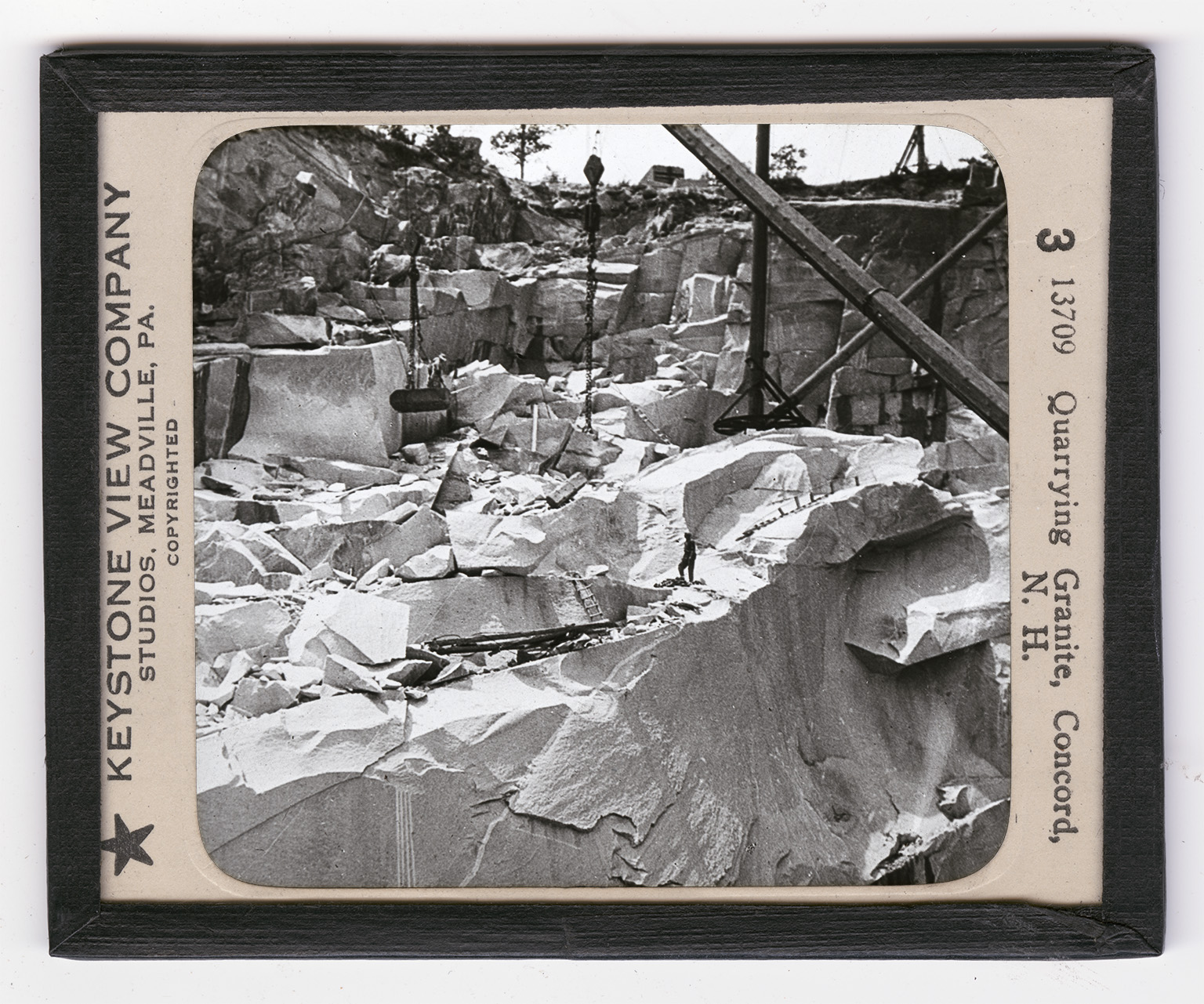
Granite is quarried, not mined. That is, it is taken out of an open shaft, with no underground shafts leading off from the main opening, as is the case in marble quarries. The view shows a great granite pit, --one of the largest in the United States. The stone is in layers, and is so very hard that it has to be blasted loose. The men in the foreground are busy splitting them into proper sizes. The stone is quarried in this manner. A foreman measures out on a layer the shape desired. On the line so laid down holes are drilled and charges of powder are inserted. These charges are set off, hurling a great mass of stone into the bottom of the quarry. The stones are then worked down by drills run by compressed air, and by hand tools such as you see the workman using. The kind of granite you see here is rather easily working because it splits like
Card Back:
wood. Its grain is so straight that steel wedges can be used to block the stone into the desired sizes. You perhaps have seen buildings partly made of granite. It is used in many of our great monuments, and every graveyard has many tombstones of this material. It is ground in many colors, --red, pink, gray, and nearly white. These colors are usually streaked with veins of darker or lighter shades. The stone is found in more than half of our states. The center of the industry is in New England. Maine, New Hampshire, Massachusetts, Connecticut, New York, Michigan, and California all have important granite quarries. The leading quarries in New Hampshire are at Concord, Milford, North Conway, and Fitzwilliam. At Keene, New Hampshire, is the second largest cutting shed in the United States.