Negative Number: 10558
Latitude: 41.0
Longitude: 74.0
Geographical Classification:
North America: United States and Possessions (Except Asiatic Possessions): Middle Atlantic States: New York
Card Front:
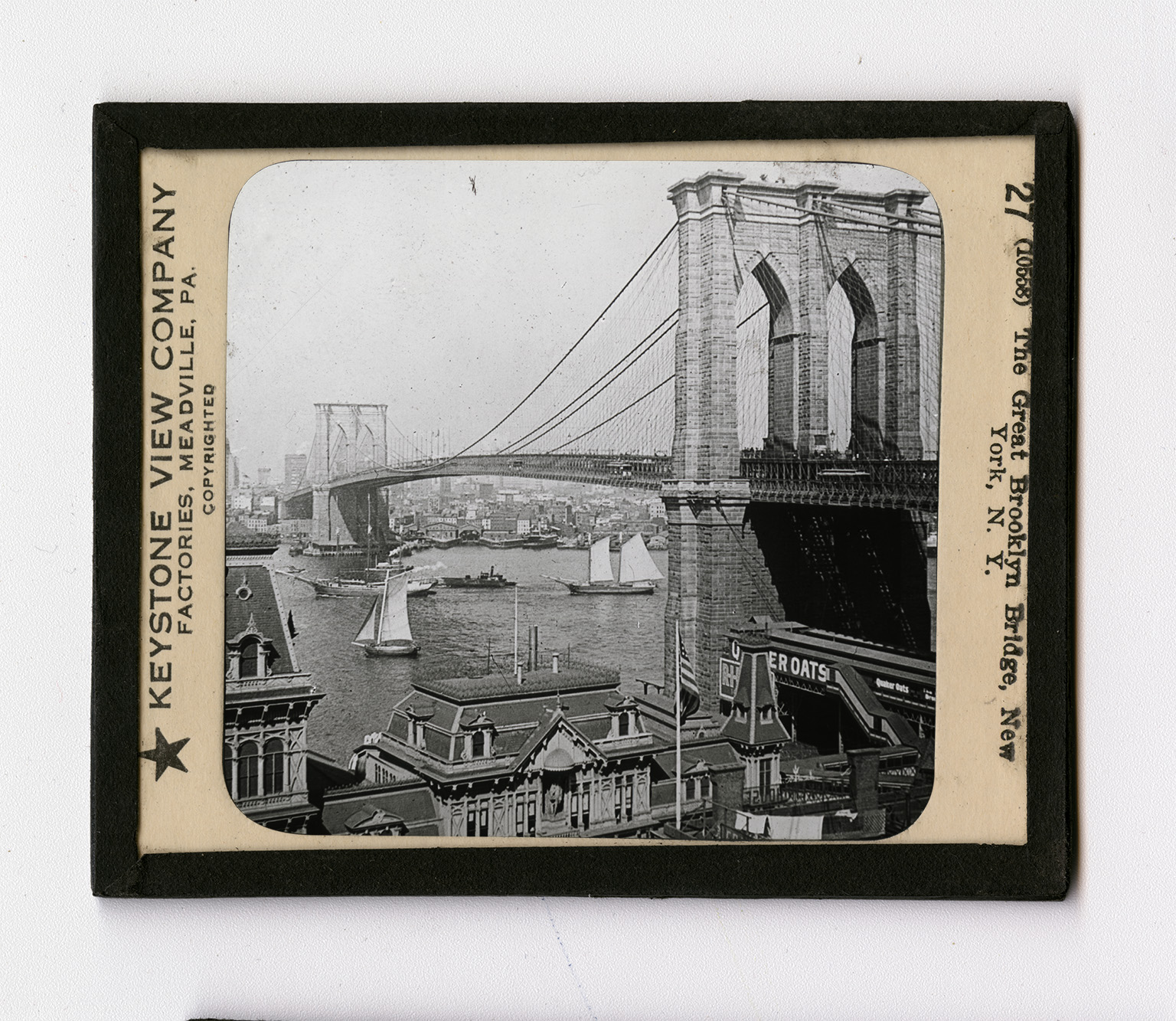
Here is a wonderful view of a remarkable structure. The Brooklyn bridge can well be called remarkable even though it has been built for a great many years. From end to end it is 5,989 feet long. It is 85 feet wide, and 135 feet above the water midway between the two piers. The piers are made of stone that rest on the rocky bed of the river 80 feet below the surface on the New York side and 45 feet below on the Brooklyn side. Over their tops are stretched four steel cables, each one 16 inches in diameter and anchored at each end by thousands of yards of solid masonry. Each of these cables weighs 3600 tons. The structure is called a suspension bridge because of these cables. These great steel ropes, fastened at either end, carry or support the weight of the bridge. Steel cables running up and down are fastened to the main cables, and to these uprights the steel framework is attached.
Card Back:
The entire bridge is made of iron and steel. On the bridge there are two roadways for wagons and carriages, one on either side, with a wide footpath in the middle. There are two railway tracks, besides tracks from trolley cars. It is estimated that on an average over 300,000 people cross the bridge daily. The bridge was built at a cost of $15,000,000. It took 13 years--from 1870 to 1883--to construct it. The chief engineer who made the plans for the bridge was John A. Roebling. The Brooklyn Bridge connects the Borough of Manhattan with the Borough of Brooklyn. Near the Brooklyn end of the bridge is located the United States Navy Yard. This is one of the chief naval stations of our country. Here battle ships come to be repaired to rest, awaiting orders from the Navy Department. The yard covers an area of about 144 acres.