Negative Number: 10156
Latitude: 21.0
Longitude: 158.0
Geographical Classification:
North America: United States and Possessions (Except Asiatic Possessions): Outlying Possessions of the United States (Except the Philippines and Guam): Hawaii
Card Front:
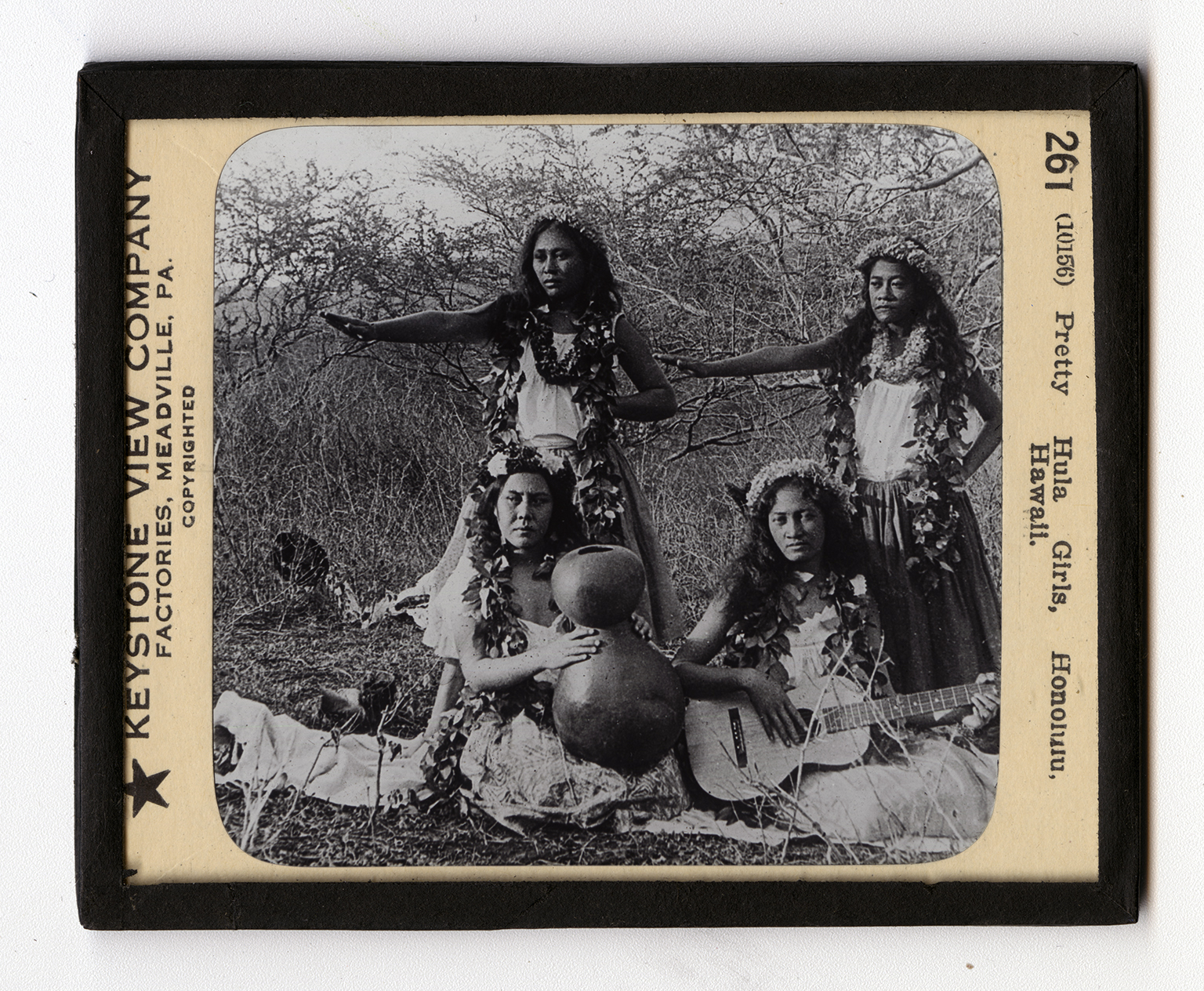
These are native Hawaiian girl dancers. They are called hula dancers because the hula is one of the ancient dances of the natives. On feast days and at their entertainments, this dance was commonly given to the music of gourds, tom-toms, flutes, guitars, or ukuleles. On such occasions the girls decorate themselves with strands and crowns of flowers. The Hawaiians belong to the brown race. It is supposed that they came from the Soviety Islands in about the 6th century. They were skillful seamen and sailed their large, double-bottomed boats far away from their native shores. The Spaniards discovered the Hawaiian Islands in 1555. Two hundred years later Captain Cook touched on their shores. He names the Sandwich Island, after the Earl of Sandwich in England. The islands were independent and had a native ruler until 1898, when they were annexed to the United States.
Card Back:
The group consists of 12 islands, 8 of which are inhabited. The largest of these is Hawaii, from which the group receives its name. They are located in the Pacific about 2,000 miles southwest of San Francisco and 4,700 miles east of Manila. They are important not only because of their production fo sugar and tropical fruits, but also because they afford an important naval base in the Pacific. The group is often spoken of as the key to the Pacific. The scene here shown is near Honolulu, in the crater of Punch Bowl Mountain. This is an extinct, volcano. Honolulu is the capital of the territory of Hawaii, and is the chief city. It has a population of about 53,000, or is about the size of Springfield, Illinois. It is on the island of Oahu. It is the largest city and the chief port of the islands. Most of the Pacific steamship lines call at this port.