Negative Number: 10154
Latitude: 19.0
Longitude: 156.0
Geographical Classification:
North America: United States and Possessions (Except Asiatic Possessions): Outlying Possessions of the United States (Except the Philippines and Guam): Hawaii
Card Front:
The Hawaiian islands are of volcanic formation. There are many mountains and still some active volcanoes in the islands. One of the largest of these is called Mauna Loa. This upland is made up largely of lava formation which covers a large part of the southern portion of the island of Hawaii. In many places the lava lies in great sheets, on which nothing grows. In other sections, where the rainfall is heavy, the lava has been made into soil, and there are dense forests. The valleys made up of volcanic ashes and lava deposits are extremely fertile. Mauna Loa is 13,675 feet above sea level. It is still an active volcano which breaks forth for a few days at a time. Then the volcano is quiet for many months. The crater is almost 4 miles long and 2 miles wide. About it has been built up a wall, which it its highest part is about 1,000
Card Back:
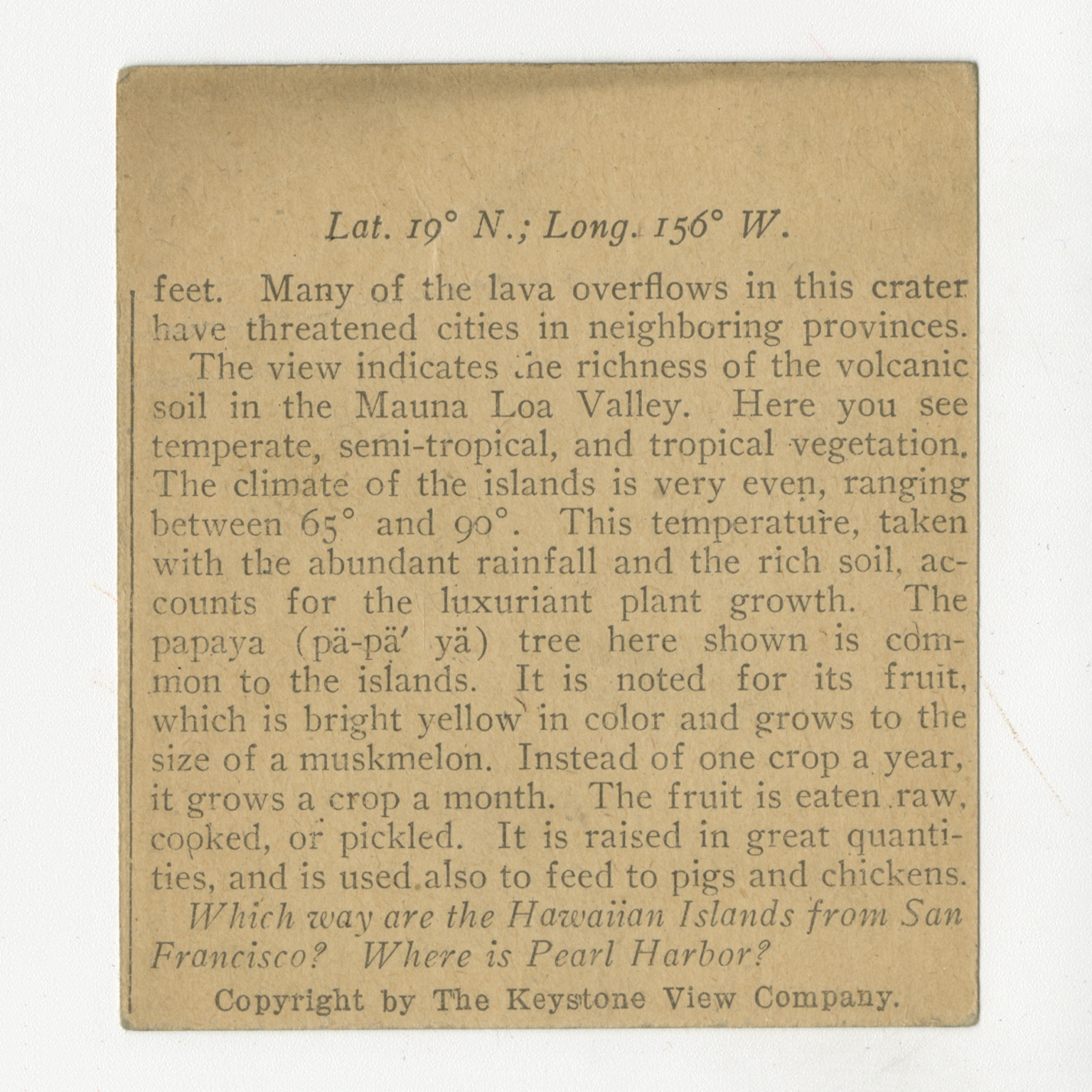
feet. Many of the lava overflows in this crater have threatened cities in neighboring provinces. The view indicated the richness of the volcanic soil in the Mauna Loa Valley. Here you see temperate, semi-tropical, and tropical vegetation. The climate of the islands is very even, ranging between 65 and 90. This temperature, taken with the abundant rainfall and the rich soil, accounts for the luxuriant plant growth. The papaya tree here shown is common to the islands. It is noted for its fruit, which is bright yellow in color and grows to the size of a muskmelon. Instead of one crop a year, it grows a crop a month. The fruit is eaten raw, cooked, or pickled. It is raised in great quantities, and is used also to feed to pigs and chickens. Which way are the Hawaiian Islands from San Francisco? Where is Pearl Harbor?