Negative Number: 21783
Latitude: 10.0
Longitude: 80.0
Geographical Classification:
North America: United States and Possessions (Except Asiatic Possessions): Outlying Possessions of the United States (Except the Philippines and Guam): Panama, C. Z.
Card Front:
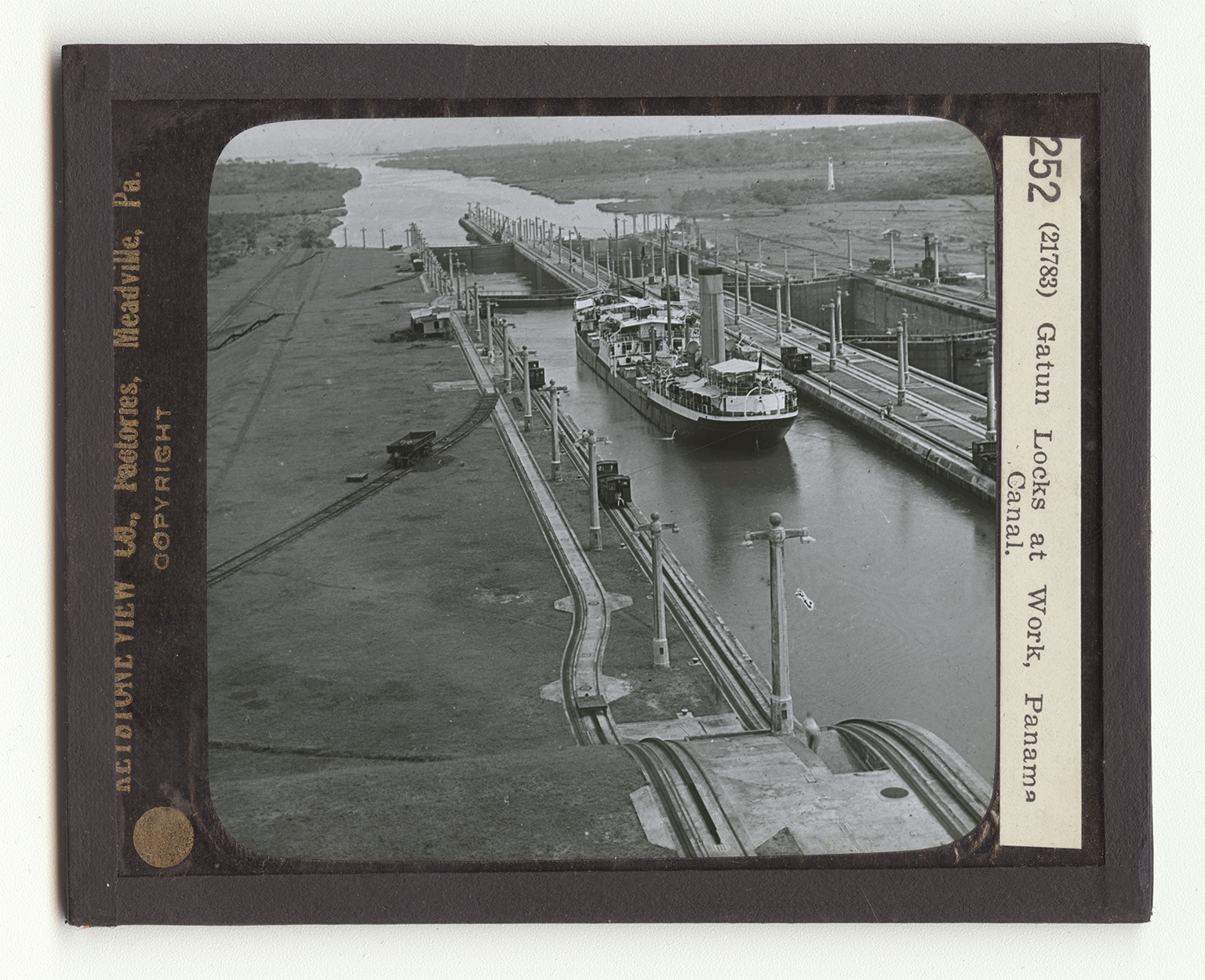
This view shows a vessel in the famous Gatun Locks of the Panama Canal. You are facing the Atlantic, which you can see in the background. Just beyond the locks the Canal is built at sea-level height. What is the need of the lighthouse in the field? The Gatun Locks are made up of three pairs of locks. That is, a ship has to make three flights to get from the sea-level to Gatun Lake to which the locks lead. And the locks are built in pairs - two side by side - as you observe in the picture. The set to the right has no water in it that can be seen. The ship here shown is going away from you. That is, it is going from Gatun Lake down to the Atlantic. The engines nearest you are holding the vessel back to keep it from jamming the lock gate. The way a lock is operated is simple. A ship
Card Back:
goes into the lock and the gate behind it is closed. Then water flows from a lake into the lock. The vessel is thus lifted as high as the walls of the lock. When the water is on a level with the with the water in the channel above, the gate ahead of the vessel is opened. In this way a vessel can be lifted any number of times till the upper channel has been reached. The ship is then free to go on. In the Panama Canal the gates at either end of a lock are double. If one is broken or gives way, the other will prevent the escape of the water. Observe the electric lights; the double tracking system for the engines; the distance the ship has been lowered in coming from the lock above. Why are the cogs between the car tracks? Explain and show by a diagram how a lock works.