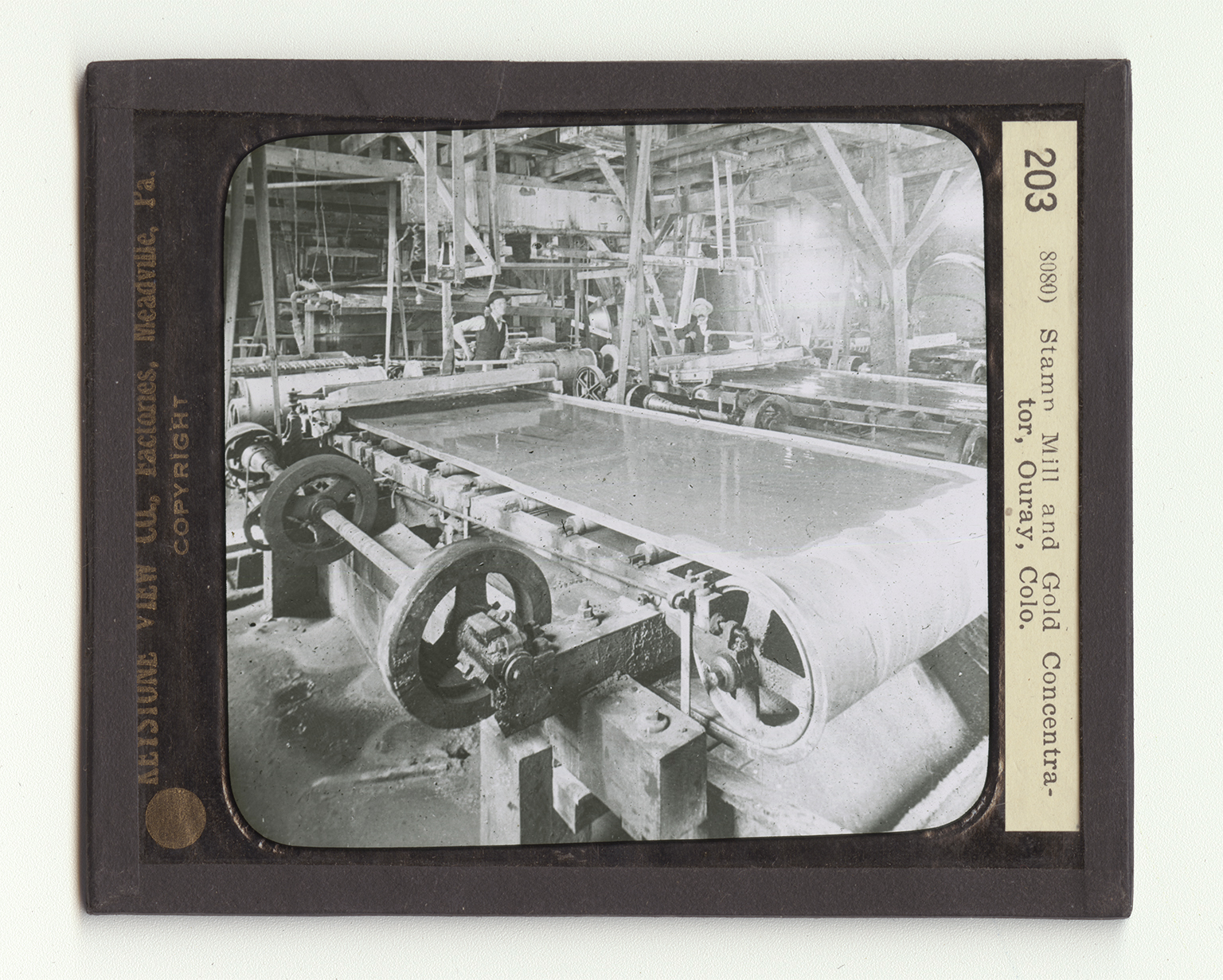
Negative Number: 8080
Latitude: 38.0
Longitude: 108.0
Geographical Classification:
North America: United States and Possessions (Except Asiatic Possessions): Plateau States: Colorado
Card Front:
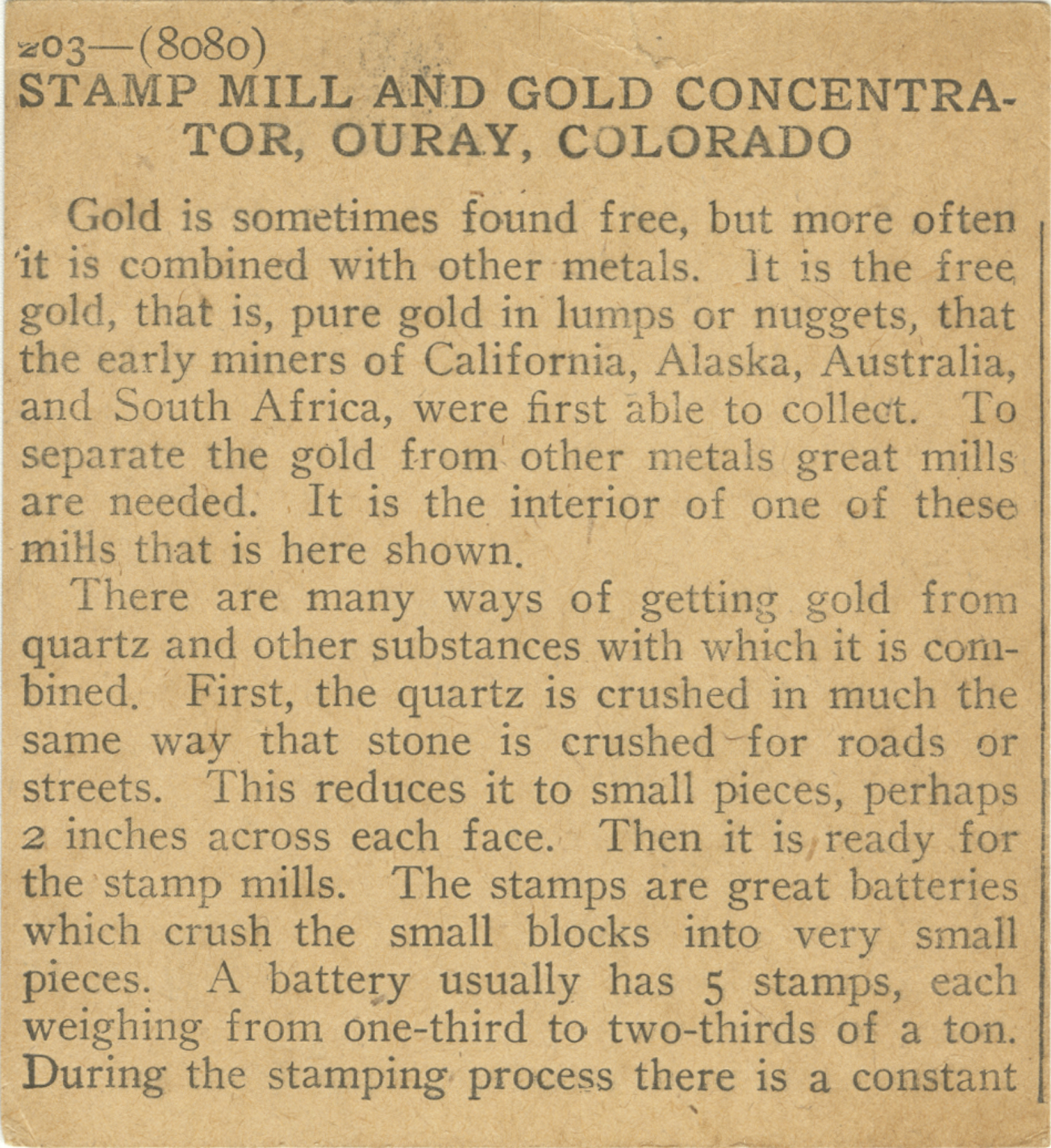
Gold is sometimes found free, but more often it is combined with other metals. It is the free gold, that is, pure, gold in lumps or nuggets, that the early miners of California, Alaska, Australia, and South Africa, were first able to collect. To separate the gold from other metals great mills are needed. It is the interior of one of these mills that is here shown. There are many ways of getting gold from quartz and other substances with which it is combined. First, the quartz is crushed in much the same way that stone is crushed in much the same way that stone is crushed for roads or streets. This reduces it to small pieces, perhaps 2 inches across each face. Then it is ready for the stamp mills. The stamps are great batteries which crush the small blocks into very small pieces. A battery usually has 5 stamps, each weighing from one-third to two-thirds of a ton. During the stamping process there is a constant
Card Back:
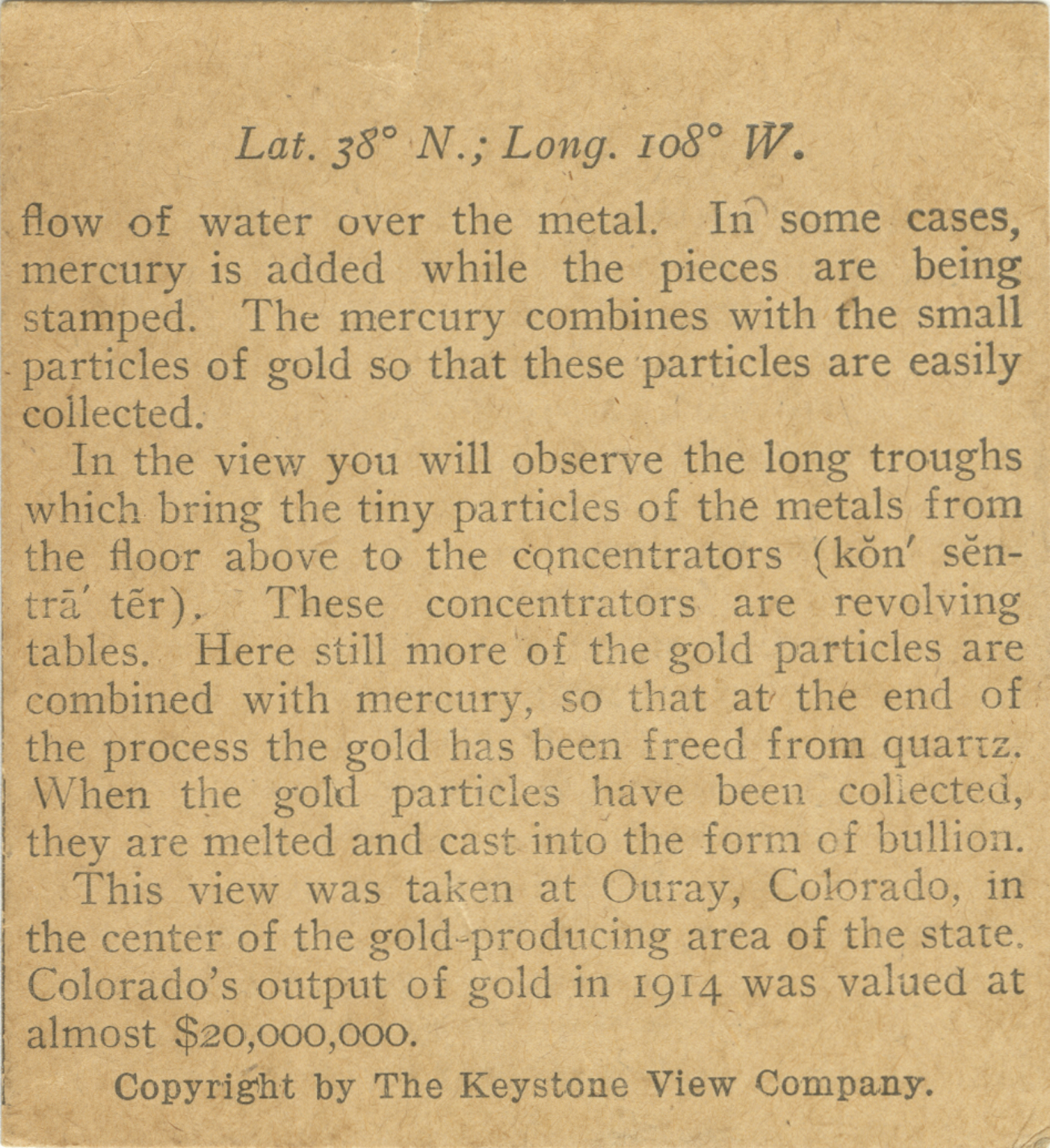
flow of water over the metal. In some cases, mercury is added while the pieces are being stamped. The mercury combines with the small particles of gold so that these particles are easily collected. In the view you will observe the long troughs which bring the tiny particles of the metals from the floor above to the concentrators. These concentrators are revolving tables. Here still more of the gold particles are combined with mercury, so that at the end of the process the gold has been free from quartz. When the gold particles have been collected, they are melted and cast into the form of bullion. This view was taken at Ouray, Colorado, in the center of the gold-producing area of the state. Colorado's output of gold in 1914 was valued at almost $20,000,000.