Negative Number: 16748
Latitude: 41.0
Longitude: 97.0
Geographical Classification:
North America: United States and Possessions (Except Asiatic Possessions): North Central States: Nebraska
Card Front:
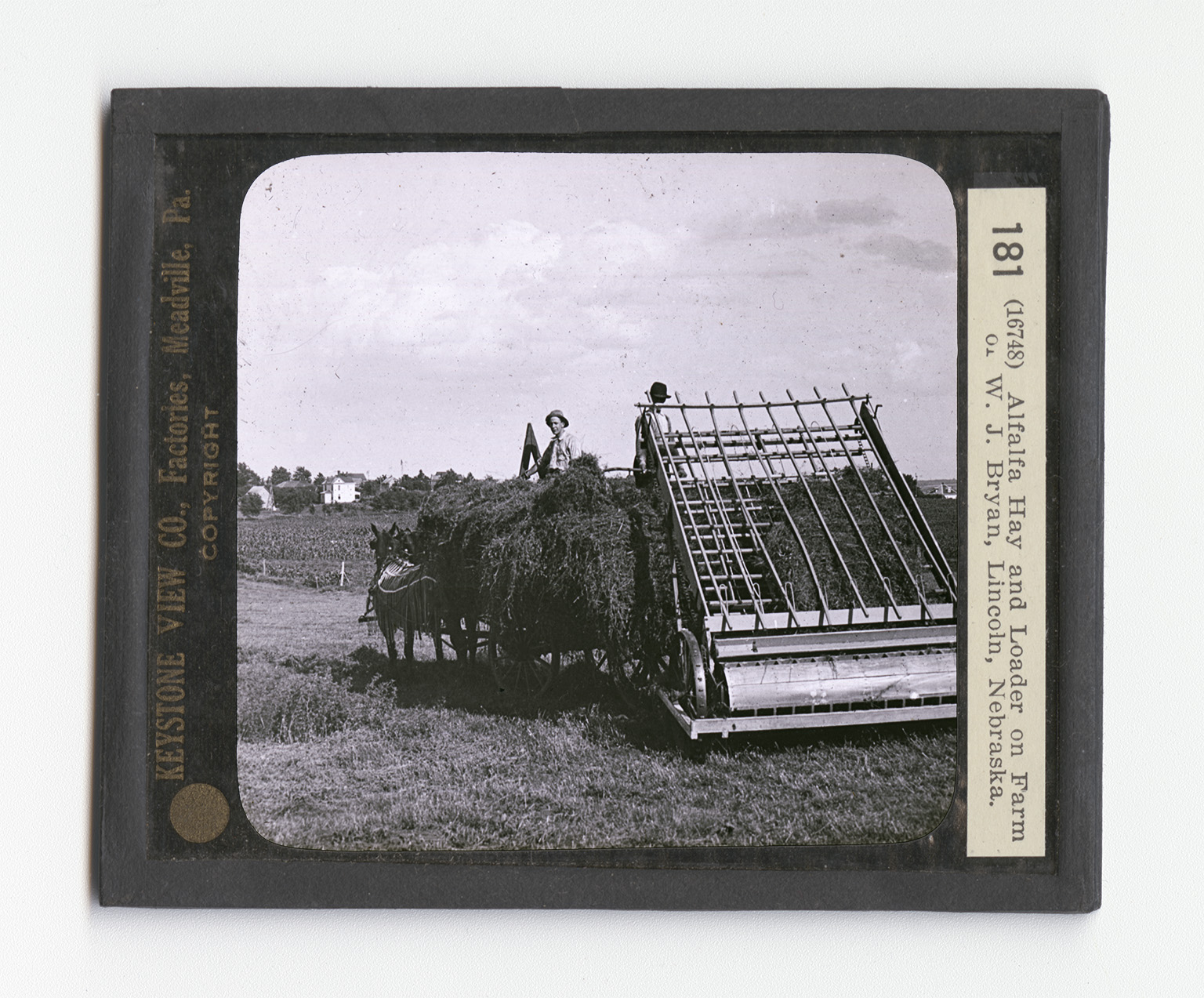
Here is a useful, labor-saving agricultural tool. It is a device to pick up hay from the meadows and lift it to the top of a wagon. This is done by a series of wire hooks fastened on long strips which work on an eccentric. As the machine akes its way across the field, these hooks work like so many hands, each grabbing its little bunch of hay. These bunches are passed on from hook to hook till they fall on the load. This method of hay loading is a great advance over the other method of pitching the hay on wagons with hand forks. To load hay by the older method, it is necessary to rake it in windrows, pile it in bunches, and then toss it to a man who arranges the bunches on the wagon. The view shows that a driver and one man can easily handle the outfit. Alfalfa is an old forage crop. It was grown by the Medes and Persians in western Asia more
Card Back:
than 2000 years ago. When Greece was boasting of its great painters and artists, its farmers were raising their fields of alfalfa. The plant moved westward with civilization; first to Italy, then Spain, then France, and thence into Germany. It was brought to the United States during the Revolutionary War but little was done with it until after the middle of the 19th century. The story goes that the miners on board the ships bound for the gold fields of California saw in Chili great fields of alfalfa. They brought some of the seed with them, and in California the plant thrived. From that state, its cultivation spread eastward until now it is looked upon as one of our most promising forage crops. Its yields are heavy. Four crops are often harvested from the same field each summer, and in the south 5 crops are sometimes cut.