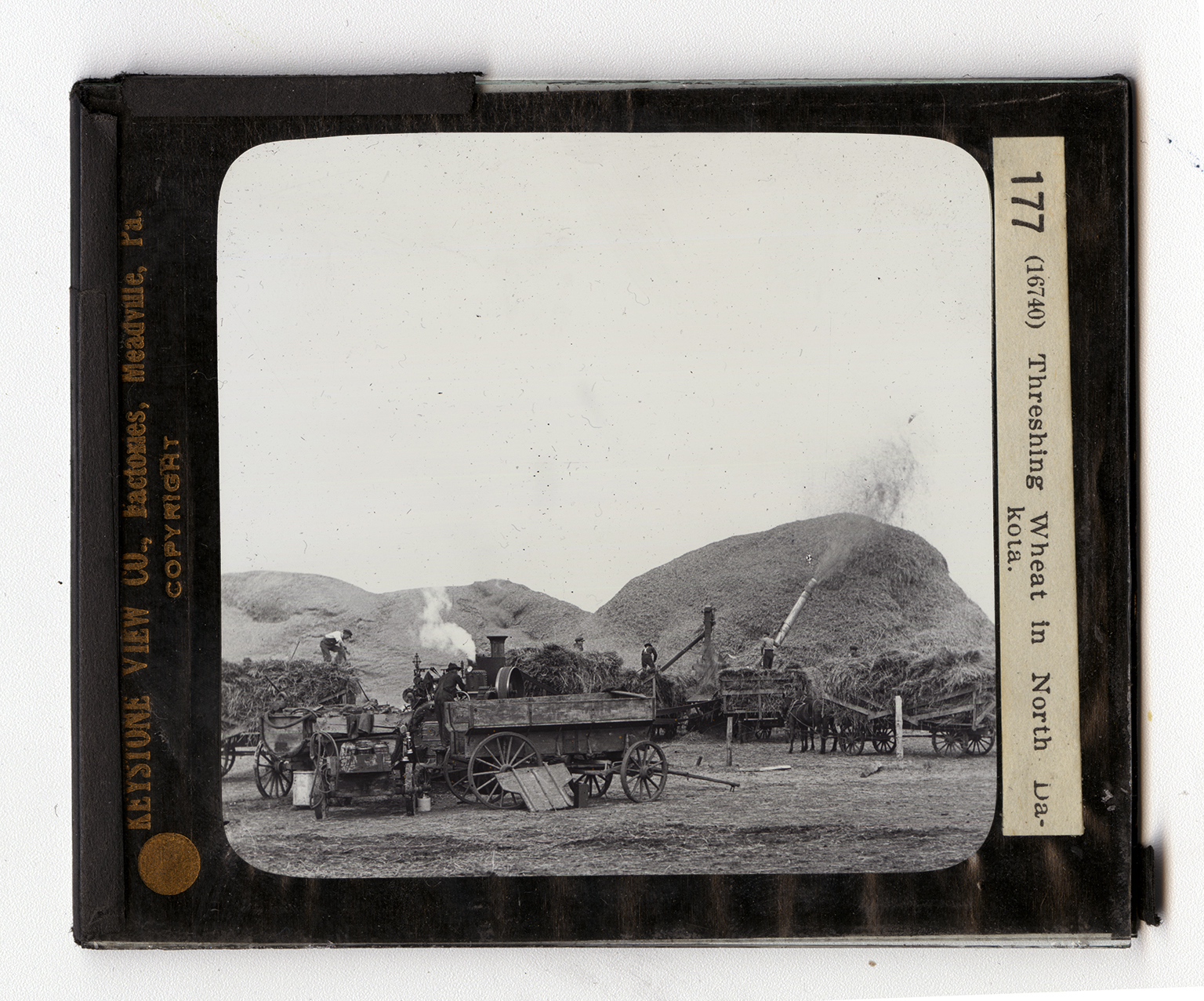
Negative Number: 16740
Latitude: 48.0
Longitude: 98.0
Geographical Classification:
North America: United States and Possessions (Except Asiatic Possessions): North Central States: North Dakota
Card Front:
Wheat is grown in many parts of our country; but the great wheat-producing states are west of the Mississippi River. Kansas, North Dakota, Minnesota, Nebraska, and Washington together produce almost half the wheat grown in the United States. Wheat is sown in the fall or in the spring. The ground is first broken up by large plows. In North Dakota and other prairie states a great engine pulls anumber of plows behind it. The fields look to be endless. There are few fences so that you can hardly tell where one field ends and another begins. Harrows are often hitched behind the plows. When the soil is pulverized, the seed is sown by drills. The young wheat plants grow rapidly, and spread, or "stool." By midsummer the wheat is ready to harvest. It has turned a beautiful yellow, and looks like a sea of gold waving in the
Card Back:
wind. Then it is cut by machines called binders, that tie the grain in sheaves and pile these sheaves in bunches. The sheaves are set in shocks by workmen. In a week or two the straw is dry enough to thresh. It is a threshing scene that is pictured here. An engine and a separator are the two parts of a threshing outfit. The engine drives the wheels and the separator does the threshing. That is, the separator removes the grain from the straw, and blows the straw into great piles. The machine weighs the grain and dumps it into wagons, or sacks. The sheaves are hauled to the machine in wagons, and are pitched into the separator with pitch forks. If the wheat crop of our country for one year was put in two-bushel sacks, and these sacks were laid in the rows, there would be 8 rows clear around world.