Negative Number: 20256
Latitude: 42.0
Longitude: 88.0
Geographical Classification:
North America: United States and Possessions (Except Asiatic Possessions): North Central States: Illinois
Card Front:
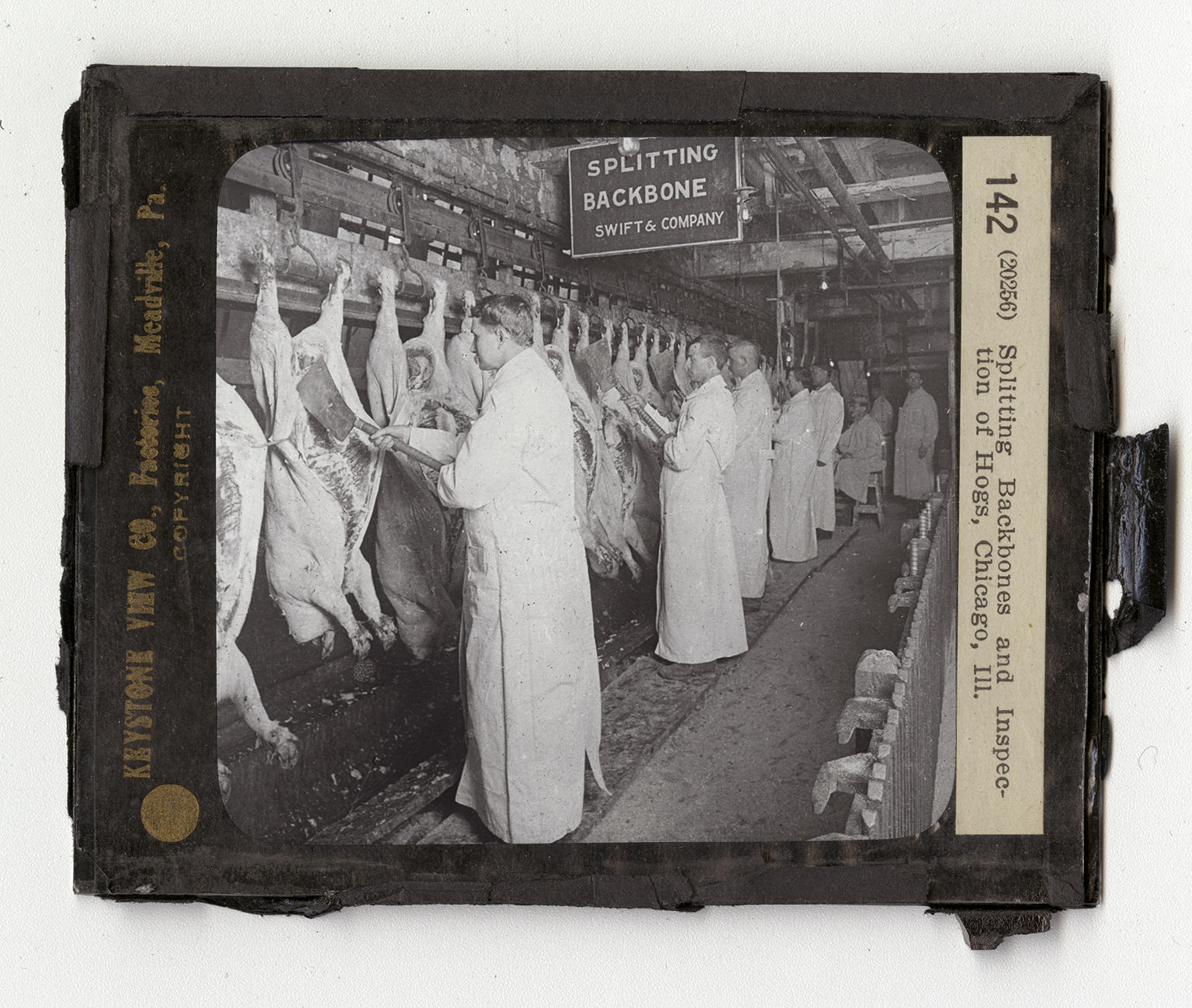
This is the final act in dressing pork in Swift & Company’s great packing house in Chicago. Here you see a row of carcasses of hogs, each suspended on hooks. You will notice that the carcasses are tied together so that the men may readily split the backbones with their huge cleavers. The tying together also makes the row a continuous one. Each of these men splits the backbones of some four or five hogs as the row is moved along the refrigerator rooms. Another row of carcasses immediately takes the place of the ones finished. This establishment slaughters about 5,000 hogs a day. The great hog-raising section of the United States is the same as that of the corn-raising areas. This is suggested by the figures that follow. In 1915 there were received in the Chicago stockyards, 7,652,071 hogs; in the Omaha stock-
Card Back:
yards, 2,642,973; in the Kansas City stockyards, 2,530,730; in the St. Louis stockyards, 2,591,768; and in the Indianapolis stockyards, 2,435,319. Iowa leads all our states in the production of swine. In 1912, within Iowa’s borders there were 9,700,000 hogs. Illinois ranks second with about half this number. Missouri, Nebraska, and Indiana follow in the order named, with numbers almost equal to that of Illinois. The United States easily leads all other countries in the world in the number of swine. Forty-two per cent of the hogs of the world are in our country. Germany ranks second with one-third the percentage of the United States; Austria third with one-half the percentage of Germany. Russia is a close rivcal of Austria. These four countries together produce 71% of the swine of the world.