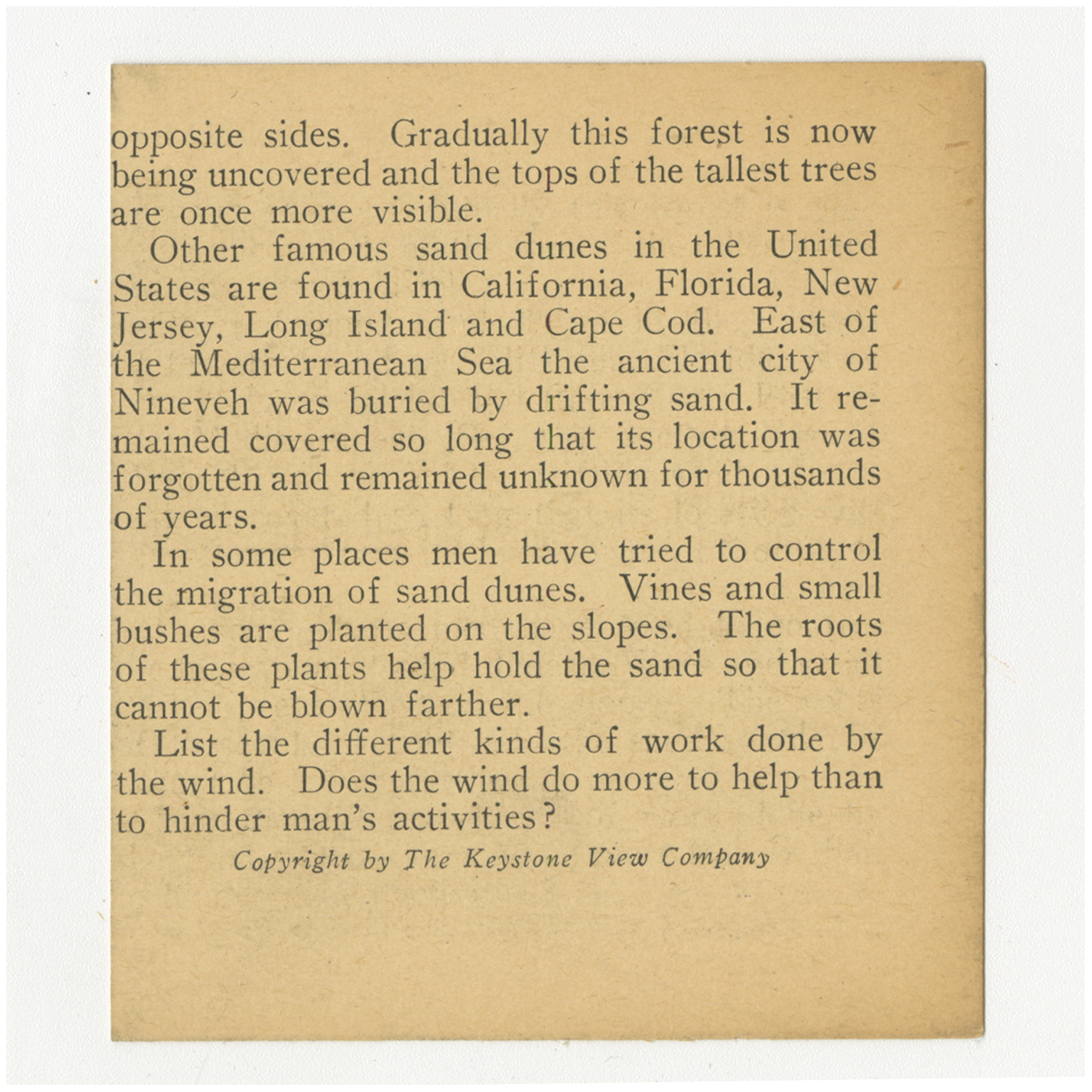
Negative Number: 21576
Latitude:
Longitude:
Geographical Classification:
North America: United States and Possessions (Except Asiatic Possessions): North Central States: Indiana
Card Front:
The man in this picture is sitting on a sand dune directly over part of a forest that has been buried by sand for many years. What appear to be dead sticks standing near him are the tops of great trees of that forest which the wind is now slowly uncovering. This interesting scene is in Dune Park on the shore of Lake Michigan in Indiana. this place was made a park because this strange and wonderful work of the wind is of great interest to many people. In this region sand has been abundant for ages, and the prevailing wind blew the loose sand before it until it reached an obstruction. Then the sand began to pile up. Very, very slowly the sand hill or dune grew higher and higher until finally the whole forest was buried. Shut off from light, air and water, the trees dried. Then the wind began to blow the sand off the tops of the dunes and roll it down the
Card Back:
opposite sides. Gradually this forest is now being uncovered and the tops of tallest trees are once more visible. Other famous sand dunes in the United States are found in California, Florida, New Jersey, Long Island and Cape Cod. East of the Mediterranean Sea the ancient city of Nineveh was buried by drifting sand. It remained covered so long that its location was forgotten and remained unknown for thousands of years. In some places men have tried to control the migration of sand dunes. Vines and small bushed are planted on the slopes. The roots of these plants help hold the sand so that it cannot be blown farther. List the different kinds of work done by the wind. Does the wind do more to help than to hinder man’s activities.