Negative Number: 13665
Latitude: 41.0
Longitude: 81.0
Geographical Classification:
North America: United States and Possessions (Except Asiatic Possessions): North Central States: Ohio
Card Front:
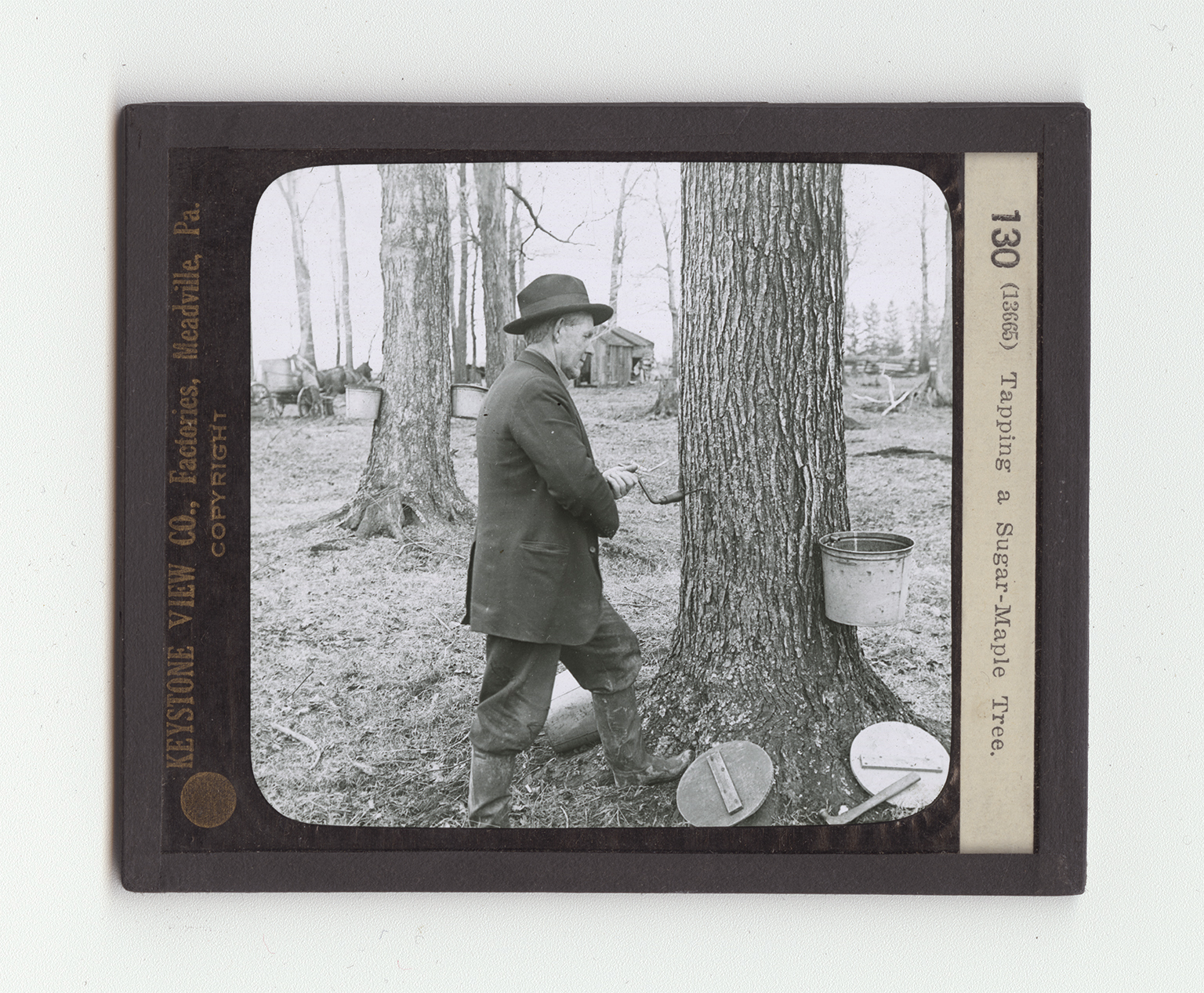
The sap of all trees rises from the roots in the spring out to the farthest twigs of the tree. In the sugar maple the sap is very sweet. That is, it contains sugar. Hence the name given to the tree. When the snow is leaving the ground, and when light freezes occur, the sugar orchards or camps are opened. It is at that time that the sap rises. Hundreds of trees are tapped; that is, they are bored into so that the sap may be gathered into pails. The man here seen is boring a hole into which he will drive a hollow metal spout. On this he will hang a pail to catch the sap. When the sun warms the tree the sap flows freely. On warm days following cold nights a productive tree will easily fill a pail the size of this one you see used. Men with teams and wagons or sleds drive around to the trees and gather in the water. The vehicles are driven to a house
Card Back:
where the sugar-water is boiled down. Here are great furnaces with large kettles full of the sweet water. All that is necessary to make maple sirup from the sap is to boil it and evaporate a certain amount of the water. When enough of the water has been removed by the boiling, a thick, sirupy fluid remains. This is maple sirup. In some orchards evaporators are used. Tanks feed the sugar-water through pipes so that at one end of the sloping vat pure sugar-water is running in. At the other end of the vat, the maple sirup flows out in a tiny stream. If the boiling is continued long enough the sirup becomes so thick that when it is cooled it forms sugar. This is the maple sugar that you buy. Vermont and New Hampshire lead all other states in the maple sugar industry.