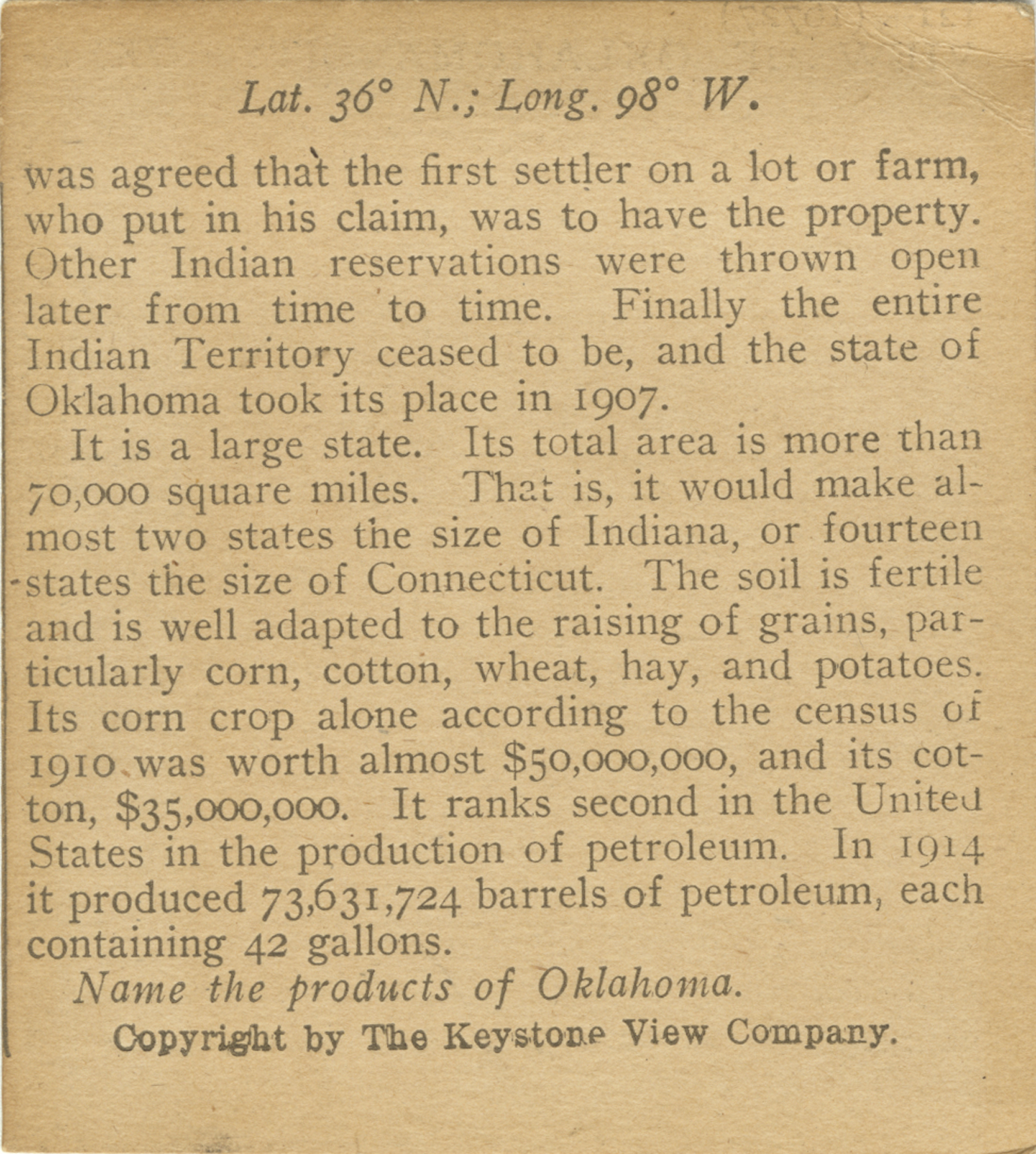
Negative Number: 16727
Latitude: 36.0
Longitude: 98.0
Geographical Classification:
North America: United States and Possessions (Except Asiatic Possessions): South Central States: Oklahoma
Card Front:
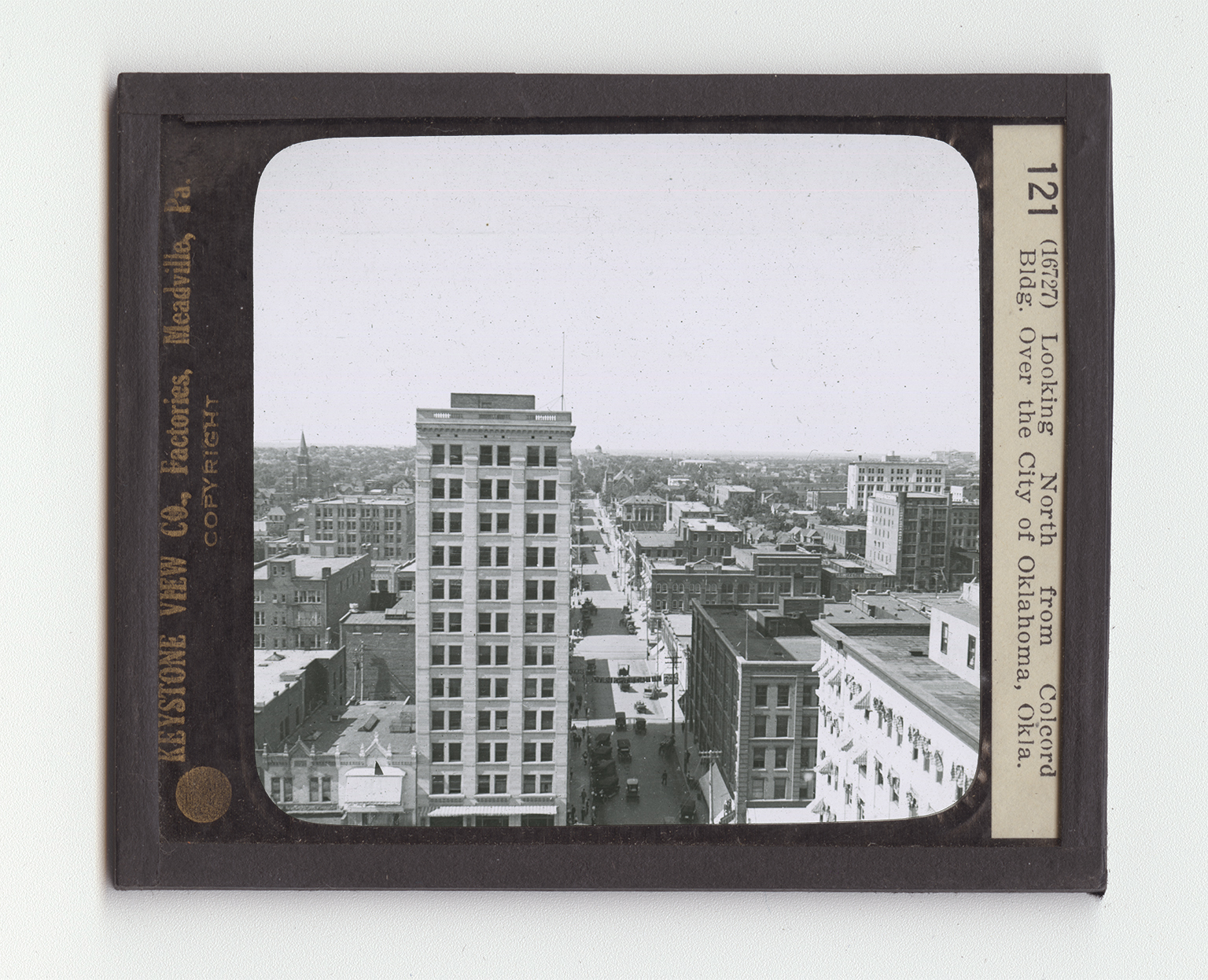
The city of Oklahoma is a metropolis of no mean size. it has a population, according to the census of 1910, of 64,205. It has great flour and grist mills, does a great deal of printing and publishing, has lumber mills and foundry and machine shops. The city is comparatively young. It was founded in 1889. It has had a wonderful growth, and has been the state capital since 1910. The world Oklahoma means "red men." And it is aptly named. It was formerly the residence of thousands of Indians. It was called the Indian Territory. The Cherokees lived in the northern part, the Creeks and Seminoles in the middle part, and the Choctaws and Chickasaws lived in the south. In the 1889 part of the land was thrown open to home seekers. Settlers collected along the border. A cannon was fired at 12 o'clock and a race began for lots and farms. The country had all been previously surveyed, and it
Card Back:
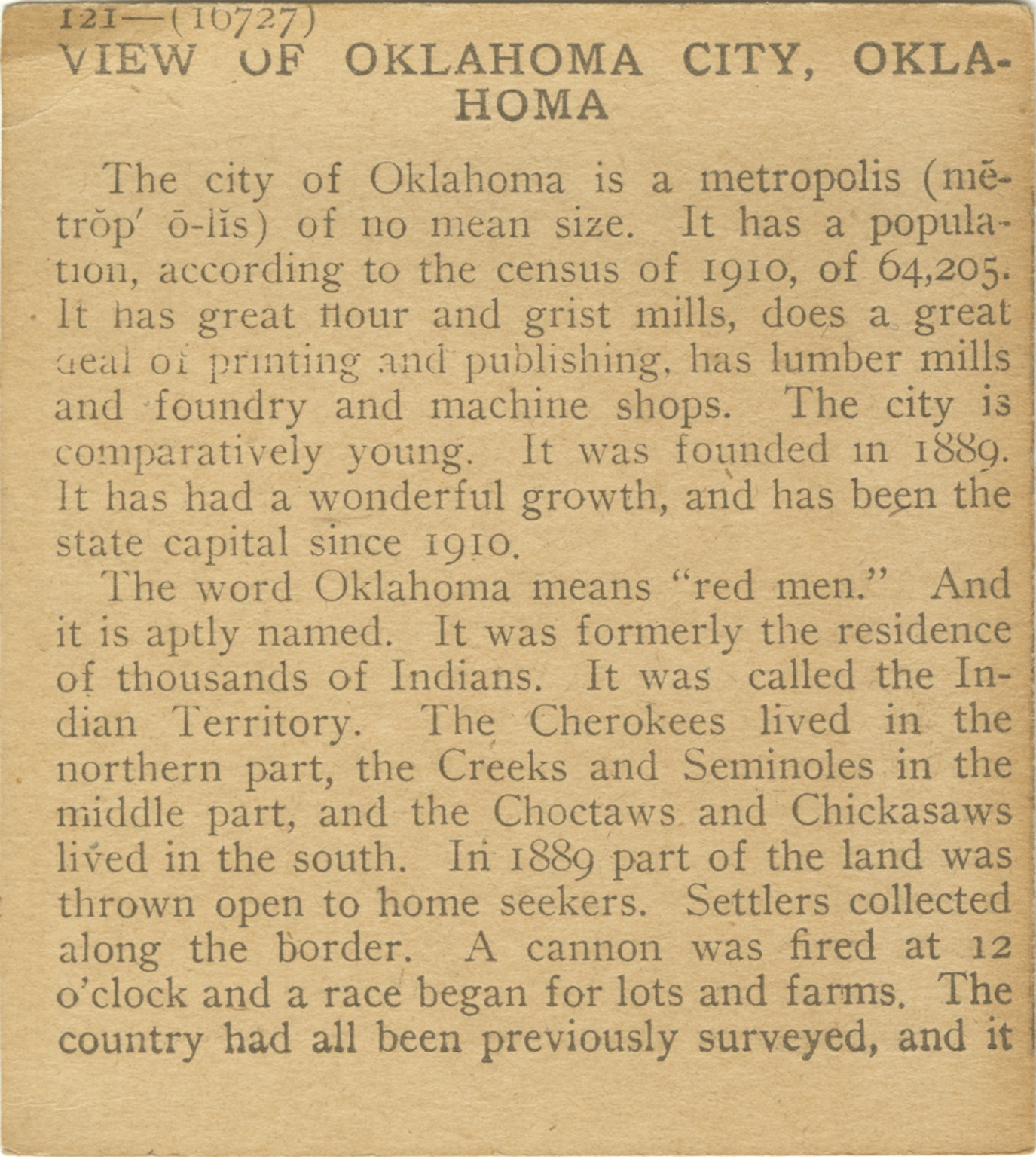
was agreed that the first settler on a lot or farm, who put in his claim, was to have the property. Other Indian reservations were thrown open later from time to time. Finally the entire Indian Territory ceased to be, and the state of Oklahoma took its place in 1907. It is a large state. Its total area is more than 70,000 square miles. That is, it would make almost two states the size of Indiana, or fourteen states the size of Connecticut. The soil is fertile and is well adapted to the raising of grains, particularly corn, cotton, wheat, hay, and potatoes. its corn crop alone according to the census of 1910 was worth almost $35,000,000. It ranks second in the United States in the production of petroleum. In 1914 it produced 73,631,724 barrels of petroleum, each contained 42 gallons. Name the products of Oklahoma.