Negative Number: 13751
Latitude: 33.0
Longitude: 80.0
Geographical Classification:
North America: United States and Possessions (Except Asiatic Possessions): South Atlantic States: South Carolina
Card Front:
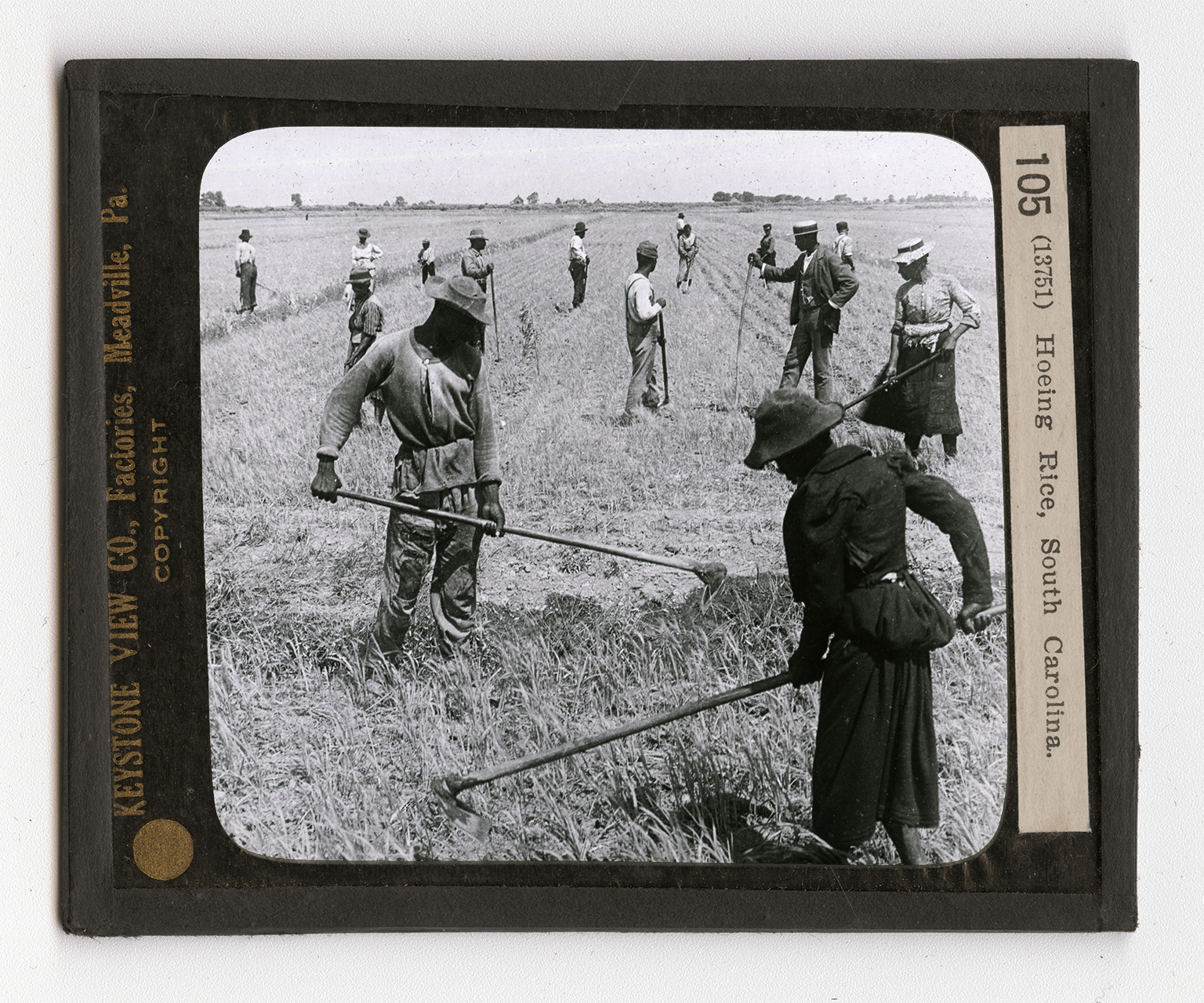
Here you have a view of rice cultivation in the old way. The ground is first plowed and a good seed-bed is made. Then the grain is drilled and the field is flooded until after the seeds sprout. Then the water is let off the fields, allowing the ground to dry. Again the field is flooded and the water is removed so that the plants may be cultivated. That is what the negroes are doing in this field. Instead of using machines, as is done generally in Texas, Louisiana, and Arkansas, these people are hoeing the weeds out. The weeds grow very rapidly, almost as rapidly as the rice. It is a serious problem for the rice farmer to keep the weeds from choking the young rice plants out. Three and sometimes four floodings are given the rice fields before the grain is full-grown. Before harvesting, all the water is drained off, allowing the soil to become dry and firm. Rice binders, machines that look like wheat binders,
Card Back:
are used to harvest it. The grain is tied in bundles, set in shocks, and later threshed. The threshing machine leaves a hull over the grain, so that the threshed grains look like threshed oats. Before the grains can be used for cooking purposes, it is necessary to mill them. That is, they are run between millstones and the outer hulls removed. The grains are then run through a polisher so that the rough ends are removed. This is the reason that the rice which you buy has its shiny appearance. The countries of southeastern Asia lead all others in the production of rice. China, Japan, Indo-China, India, and the neighboring islands grow millions of bushels every year. The chief food of the people of most of these countries is rice. The total yield in the United States in 1915 was about 402,041 tons. British India alone in 1915 produced 56,706,248 tons.